Pilot project proposed in Mykolaiv Region to study groundwater and create mapping system
- Julia Lukyanenko
-
•
-
11:00, 06 April, 2026
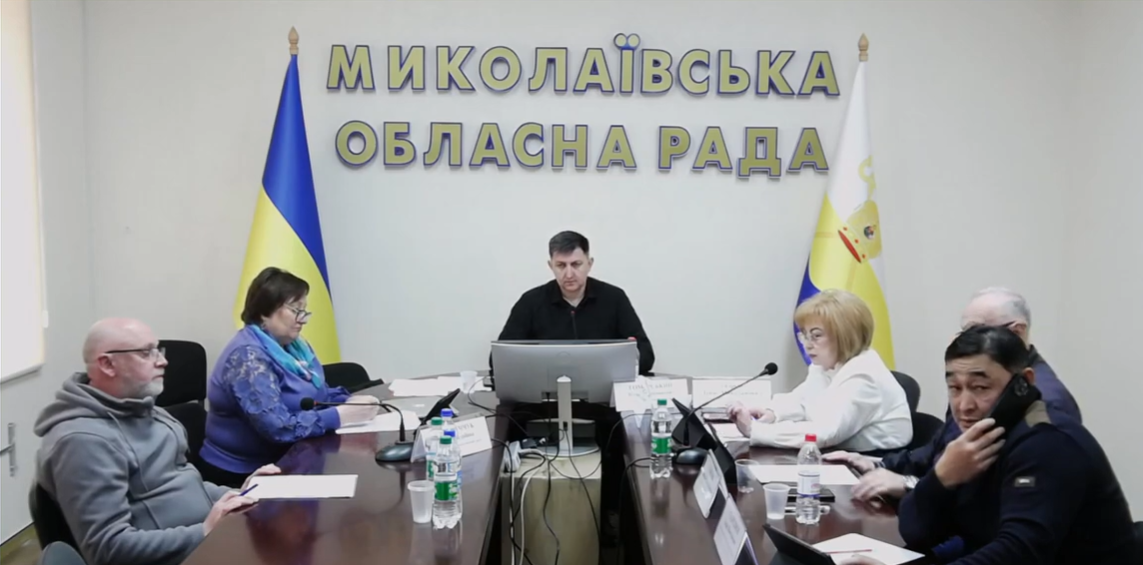 Meeting of the Committee on Regional Development. Screenshot from the broadcast
There is currently no accurate data on groundwater reserves in the Mykolaiv region. However, wells have been actively drilled recently and the climate has changed, which affects the condition of groundwater. Therefore, the region is proposing to launch a pilot project for an in-depth study of groundwater, to develop a groundwater map, and to approach the Cabinet of Ministers on this matter.
Deputies supported the draft appeal to the Cabinet of Ministers at a meeting of the Mykolaiv Regional Council’s Committee on Regional Development, Planning, Budget, Finance and Investment on 3 April, reports NikVesti.
The deputies agreed that the issue is important and that everyone is aware of the water situation.
«The south without water will turn into a barren steppe,» said committee chair Vitalii Homerskyi.
Oleksandr Malikin, deputy head of the Regional Water Resources Office in Mykolaiv region, noted that the problem of supplying Mykolaiv Oblast with drinking water worsened when Russian occupiers destroyed the Dnipro-Mykolaiv water pipeline and then blew up the Kakhovka Hydroelectric Power Station. Consequently, residents have begun to tap into groundwater — sometimes drilling wells without proper oversight. Furthermore, rivers are drying up due to climate change.
«There is currently a misunderstanding regarding our groundwater reserves, which are not particularly abundant to begin with and do not always meet sanitary standards to be classified as drinking water. But this is the only option for the residents of the Mykolaiv region,» explained Oleksandr Malikin.
Members of the regional council are being urged to appeal to the Cabinet of Ministers on behalf of the Mykolaiv region to launch a pilot project, based at the Regional Water Resources Office, to conduct an in-depth study of groundwater and develop a groundwater map.
«At present, we have no understanding of what we have, what the characteristics are, or what is happening with groundwater extraction,» noted Oleksandr Malikin.
In response to a question from councillor Takhir Sadridinov about whether there is any data on groundwater in the archives, Oleksandr Malikin explained that the most recent research results date back to 1983.
All counсillors present at the committee meeting supported the appeal.
The appeal to the Cabinet of Ministers also notes that problems with drinking water existed in the Mykolaiv region long before the war. The region’s reserves of fresh groundwater are insufficient to serve as the primary source of water supply. Climate change is also affecting rivers and water levels in reservoirs. Small rivers and ponds, which used to provide a constant replenishment of groundwater in the districts, are drying up. It was thanks to this that boreholes and wells were able to function.
«Taking into account the above-mentioned processes, and considering that, in terms of the volume of explored reserves of drinking-quality groundwater, the Mykolaiv region is the least well-provided for in Ukraine, the rational use of groundwater is a key aspect of ensuring its sustainable consumption. It is necessary to assess groundwater reserves and plan their use in accordance with the needs of the population and industry. It is important to adhere to water consumption standards and conduct regular environmental impact assessments,» the draft appeal states.
It is noted that the issue of licensing the drilling and decommissioning of wells needs to be revisited.
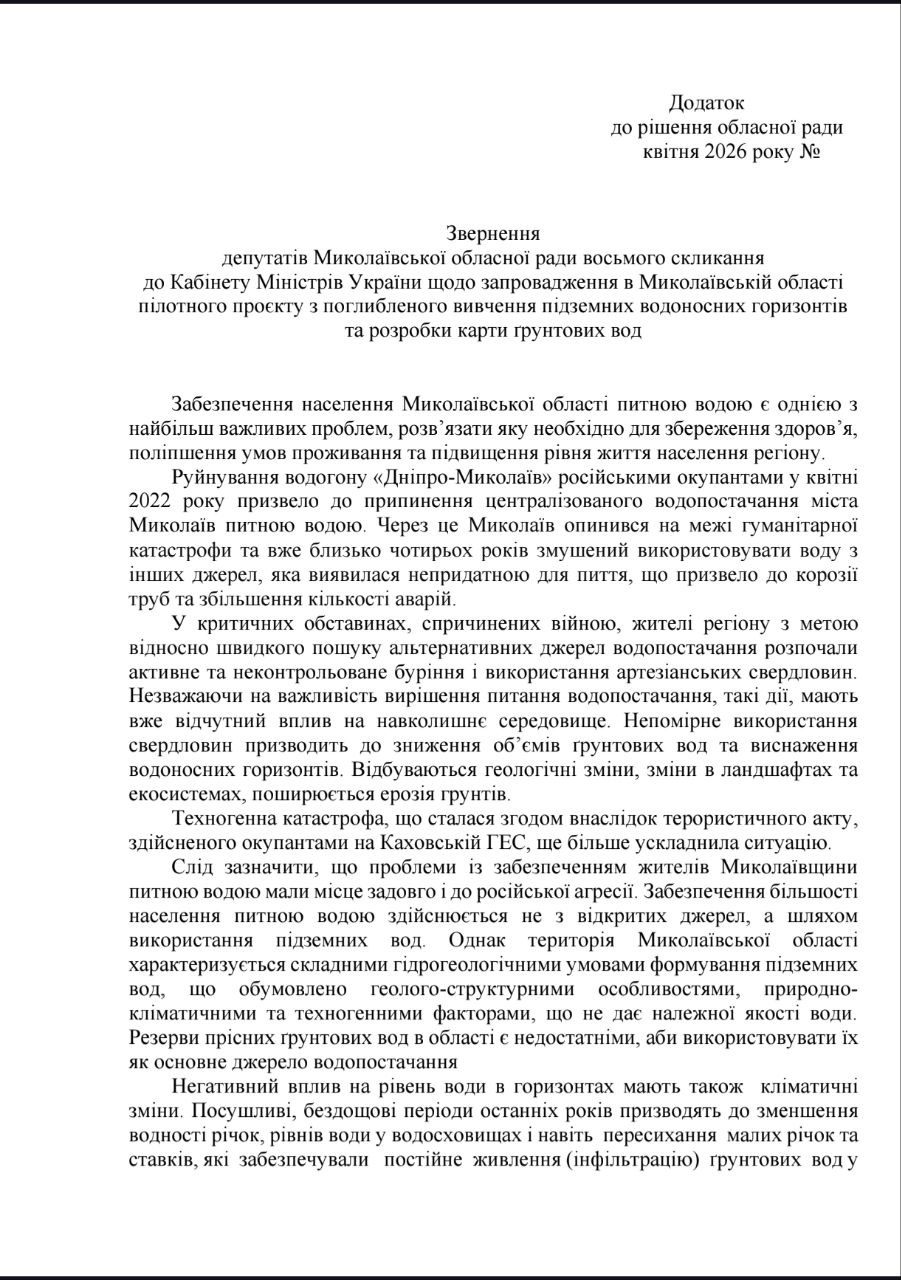 Draft appeal to the Cabinet of Ministers regarding the pilot project on groundwater development. Screenshot from the Mykolaiv Regional Council website
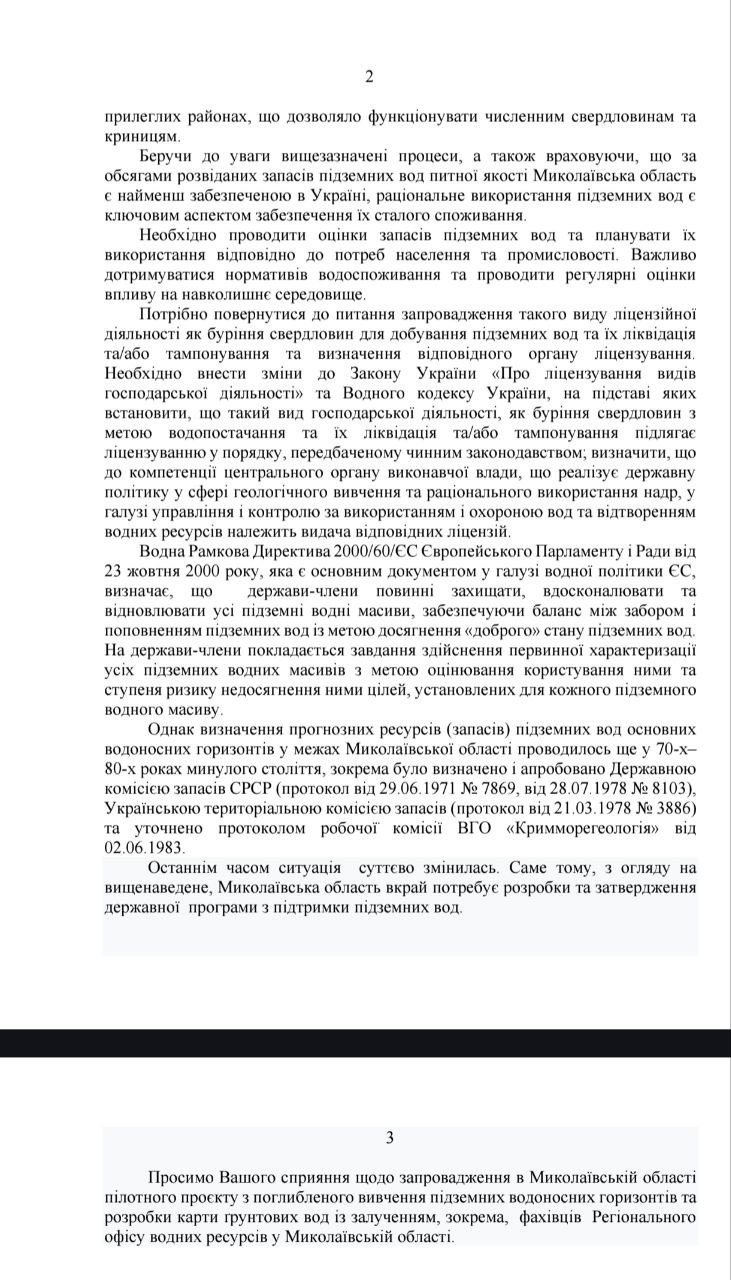 Draft appeal to the Cabinet of Ministers regarding the pilot project on groundwater development. Screenshot from the Mykolaiv Regional Council website
Water supply for Mykolaiv
It has been more than three years since Russian troops damaged the water pipeline that supplied Mykolaiv with water. Since then, the city of nearly half a million people has been left without a centralised supply of clean water.
All this time, the people of Mykolaiv have been receiving water from a backup source, which raises many questions about the quality of this water and its salt content. The salt water has damaged 1,200 kilometres of the city’s water supply network. Borys Dudenko, Director of Mykolaivvodokanal, stated that it is impossible to replace the entire length of the network damaged by the influx of salt water.
For a long time, representatives of the state and local authorities sought options for restoring the drinking water supply in Mykolaiv. A final decision was reached in 2024: a new water pipeline will be laid from Nova Odesa, with funding allocated from the state budget.
The regional reconstruction service even selected contractors who would work on a «design-build» basis. These were three companies, each responsible for one of the three sections of work: Ukrtransmist, Rostdorstroi and Avtostrada. However, both the client and the construction contractor were subsequently changed. The client for the construction of the new water pipeline became the Infrastructure Restoration and Development Service in the Dnipropetrovsk region, and the contractor was the Avtostrada group of companies.
The new water pipeline for Mykolaiv was commissioned on 7 October 2025 — it was connected to the water utility’s networks.
The Danish government is prepared to provide a grant of €45 million for the modernisation of new treatment facilities to ensure a high-quality centralised water supply for Mykolaiv.