
Two community activists from the Mykolaiv region are learning from their Swedish partners how to plan for the future of their communities
-

- Julia LukyanenkoReporter

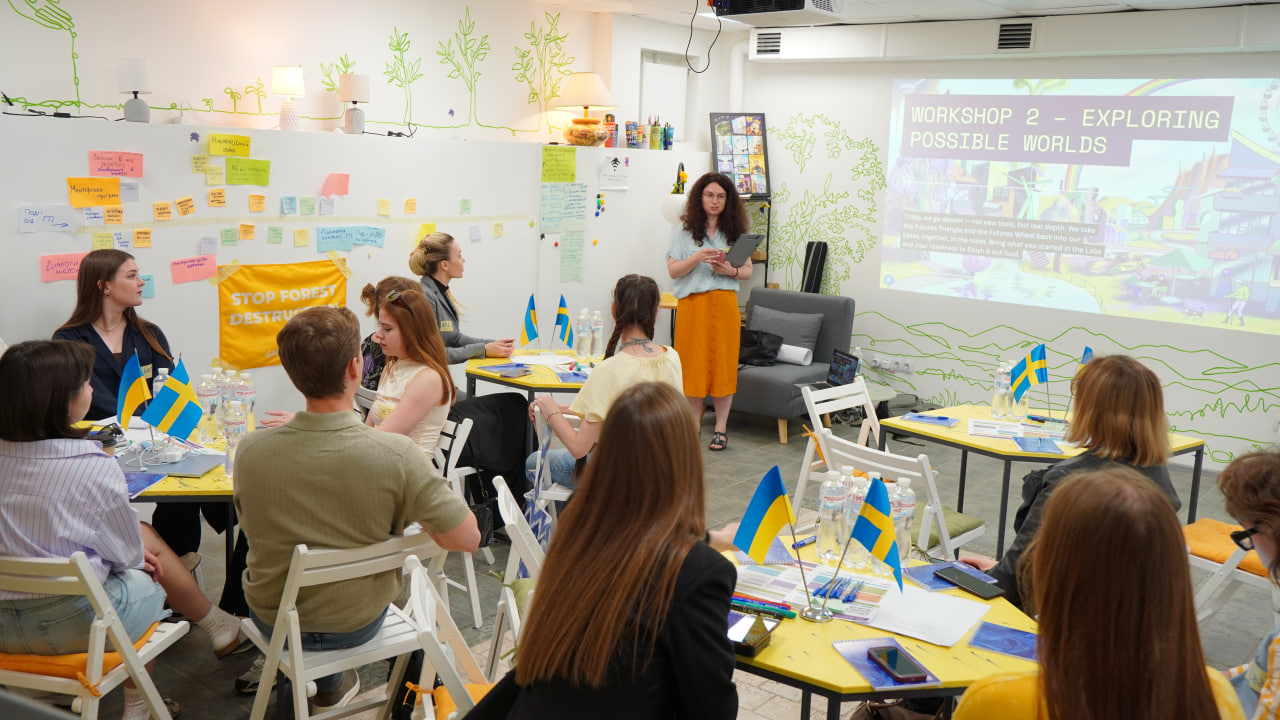 An in-person workshop as part of the «Democratise the Future» programme. Photo: programme organisers
A comprehensive training programme on long-term planning for young leaders — «Democratize the Future» — has been launched in Ukraine. It combines theory and practice, including how to develop various scenarios for community development and anticipate risks. Two participants from the Mykolaiv region have joined the programme.
Olha Riznychenko, a co-trainer on the programme, spoke to NikVesti about this.
The programme is being implemented by the «Stabilisation Support Services» charitable foundation in partnership with the MAD Foundation from Sweden, renowned for its expertise in strategic planning, with financial support from the Swedish Institute. The training will last 15 months: it began in January.
Foresight is a strategic planning method that enables the identification of long-term prospects and development alternatives, and the formulation of an action plan in advance.
«Democratise the Future» has brought together young leaders from the civil society sector, active young people and internally displaced persons. As Olha Riznychenko explained, participants are learning to look at problems not just from the perspective of «solving them here and now», but also to ask what might happen to communities in five or ten years’ time and to prepare various scenarios for how events might unfold.
«For the Mykolaiv region, which is experiencing the consequences of a full-scale war, this issue is particularly relevant. Communities in the region are simultaneously addressing people’s immediate needs whilst also having to consider what their towns and villages will look like during the recovery process: how people will return, what education will look like, and how infrastructure and the economy will develop. In such circumstances, it is important not just to have a plan, but to be able to adapt it if circumstances change,» noted Olha Riznychenko.
She explained that foresight helps to deal with uncertainty: modelling several possible future scenarios and testing how decisions will work under different conditions, and what consequences they may have in a few years’ time.
What the training involves
As Olha Riznychenko explained, the theoretical part of the training involves studying foresight tools. Participants then work in teams to analyse case studies modelled on real challenges faced by Ukrainian communities: education in remote villages, the integration of internally displaced persons into communities, the development of alternative energy, the protection of forests during the war, and post-war reconstruction of territories. They also develop various future scenarios and assess the associated risks.
During the training, experts share their experience, including representatives from the Swedish Embassy in Ukraine, the Swedish MAD Foundation and UNHCR (the UN Refugee Agency). Participants present their own foresight strategies directly to relevant specialists. The teams have already presented their ideas to representatives of WWF-Ukraine, Greenpeace and the Ministry of Education and Science of Ukraine, and received feedback on what worked well and what needs to be reviewed or adapted.
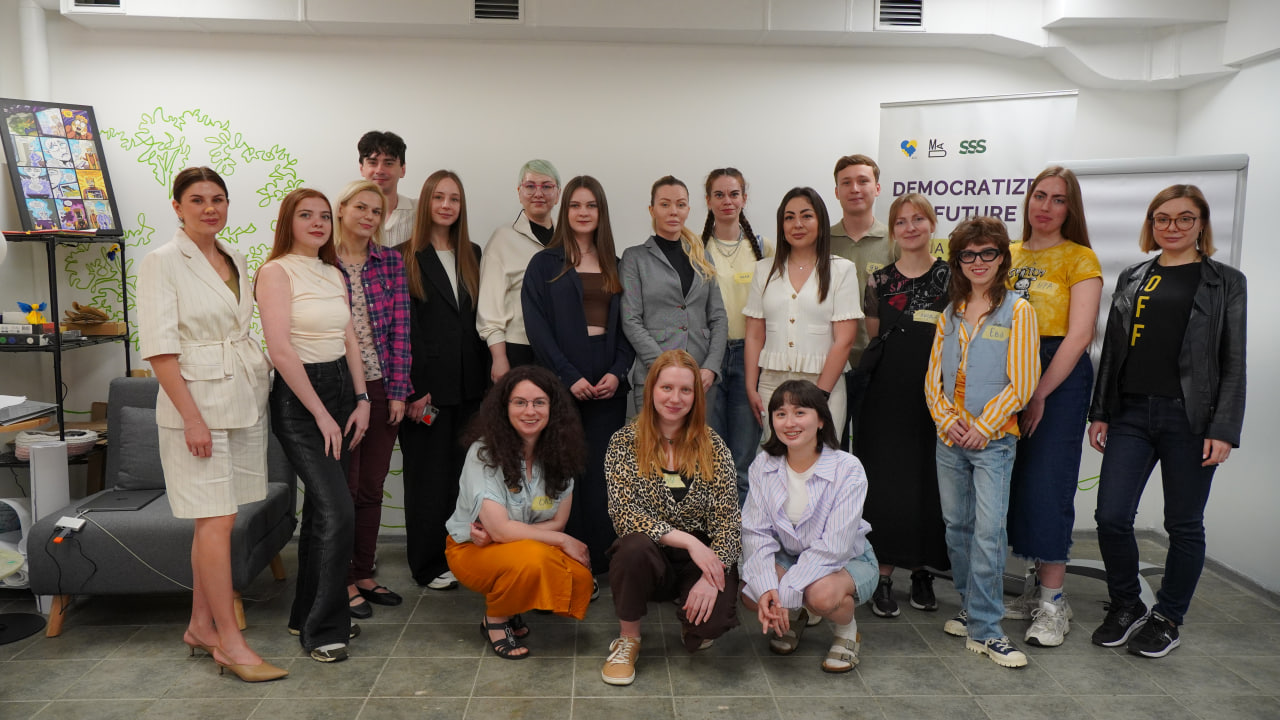 Offline workshop of the «Democratise the Future» programme. Photo: programme organisers
The next stage will involve working on real requests from civil society organisations, and in the final phase, participants will conduct their own foresight sessions on Ukraine’s recovery and European integration.
Participants from the Mykolaiv region
Forty-five young people from 17 regions of Ukraine have joined the programme. The Mykolaiv region is represented by two participants: Yuliia Olefirenko (Mykolaiv) and Valentyna Duka, a trainer in non-formal youth education and a lawyer specialising in legal awareness (Kotliareve village, Shevchenkove community).
Yuliia Olefirenko shared her expectations of the training. She said that, initially, she wanted to learn how to spot small shifts in society before they escalate into a crisis, and to forecast how events might unfold in situations of stress and uncertainty. She highlighted the opportunity to learn from colleagues in Sweden as a key aspect.
«The second thing I was looking for was a balance between living in the «here and now» and the ability to plan for and believe in the future. For many Ukrainians, living in the «here and now» has become a survival skill, and this is valuable; it sets us apart from many others and enables us to keep fighting. But if we live only like this, the community cannot develop, let alone make long-term plans. It’s important for me to learn how to hold both dimensions together. Furthermore, I believe that foresight tools really work when the people using them understand one another,» said Yuliia Olefirenko.
Among Mykolaiv’s strengths, the psychologist cited the ability to organise quickly, mutual support and flexibility. But during the war, planning has been reduced to a week or even a day.
«I live in Mykolaiv, near the front line, so even when buying tickets a couple of months in advance, I tell myself: «If it doesn’t work out, I’ll just return them or lose the money.» The same thing is happening at the level of communities and civil society organisations — projects survive from grant to grant, and every planning exercise is accompanied by the question, «Will this still be relevant in a month’s time?» Yes, organisations continue to draw up annual plans, but a new caveat has emerged: these will be reviewed and updated every quarter, so there is less faith in such plans than there was five years ago,» noted Yuliia Olefirenko.
She cited the consequences of the pandemic, blackouts and shelling as problematic issues, as these drain resources and leave less energy for strategic thinking.
«Many people, particularly internally displaced persons (IDPs), do not know whether they will remain in the community. Furthermore, there is a lack of skill in «shared visioning of the future»: we know how to react, but we rarely come together to imagine what sort of community we want to see,» the psychologist shared.
Following the training, Yuliia Olefirenko plans to run a foresight session for a partner civil society organisation. This will be her first opportunity to put what she’s learnt into practice.
«At the same time, I’m developing a board game about anti-discrimination, social inclusion and diversity. This is my answer to the question of how to make complex topics accessible, engaging and capable of changing attitudes, rather than simply conveying information. As a psychologist and trainer, I want to incorporate foresight approaches into my training sessions, workshops and intervision sessions for psychosocial support professionals. To help teams and communities not just «put out fires», but also to build a shared vision of the future in which people feel safe, have a say and feel that their voice is heard,» the psychologist shared.
Another programme participant from the Mykolaiv region — Valentyna Duka — has also taken an interest in international foresight experience and plans to apply the knowledge she has gained in her youth work.
«In my work in the field of youth policy, two factors are important to me when it comes to long-term planning: safety and the level of youth engagement. Since the war began, safety has become a broader concept. Now we need to ensure not only the safety of the physical space, but also the safety of the group environment, so that there is a level of trust amongst participants where they can speak and be heard. Maintaining group dynamics is a challenge for me. Participants’ energy levels dip, and if someone has already arrived with low energy, I need to find ways to address this so that they can engage with the material. That’s why I plan contingency scenarios in advance, adjust the programme and try out different formats,» shared Valentyna Duka.
The best participants in the programme will be rewarded with a study trip to Sweden, where they will be able to see how foresight works in practice.
As a reminder, the Centre for Resilience operates in Mykolaiv, where those affected by the war can receive free psychological, legal and social support, as well as consult a speech therapist.
There is also a mobile team operating there, which visits communities in the Bashtanka, Mykolaiv and Voznesensk districts of the Mykolaiv region. The mobile team provides the same range of services as the centre. Consultations are held at community centres, schools and other institutions within the communities.


This material was produced within the REACH – Media Partnerships for Accountability and Trust project, implemented by International Media Support (IMS) and supported by the Ministry of Foreign Affairs of Denmark. The content reflects the views of the authors and not necessarily those of the Danish government. Denmark’s support strengthens civil society and independent media in Ukraine, including in Mykolaiv.

