Ghost cars, or why abandoned vehicles have been standing on the streets of Mykolaiv for years
- Alona Kokhanchuk
-
•
-
12:41, 16 September, 2026
 One of the abandoned cars on the streets of Mykolaiv. Photo: NikVesti
Mykolaiv has been grappling with the problem of abandoned cars for years. On the streets, you can see cars that have effectively become part of the street furniture. Some have smashed windows, flat tyres, missing parts, and interiors cluttered with rubbish. At the same time, such cars continue to occupy parking spaces, and the city often has no legal grounds simply to remove them.
A procedure for towing away abandoned cars has already been drawn up in Mykolaiv, but it cannot be implemented.
NikVesti investigated why the city cannot resolve this issue and what is standing in the way.
Abandoned cars have been taking up spaces for years
The problem of abandoned cars became particularly noticeable after the start of the full-scale war. Some cars were left behind by their owners due to evacuation, mobilisation, damage caused by shelling or departure from the city.
These cars are parked in residential areas, on roadsides and in courtyards. Some of them are gradually turning into scrap metal, cluttering up the area and taking up parking spaces.
Residents of Mykolaiv themselves regularly complain about the problem, particularly via the Facebook group «Contact Centre at Mykolaiv City Council».
For example, residents of the building at 14 Svitla Street have asked for a car to be removed which, they say, has been sitting in the courtyard for a long time in a wrecked and non-functional state. The car is not being used and is taking up space. As the author of the appeal, Tetiana Bozhko, notes, the car has already become a shelter for cats and dogs.
«I request that an investigation be carried out, the owner of the vehicle be identified and, where there are legal grounds to do so, arrangements be made for its removal (towing) or other measures be taken in accordance with current legislation,» the petition states.
 Complaint about an abandoned car. Photo from the Contact Centre at Mykolaiv City Council
 Complaint about an abandoned car. Photo from the Contact Centre at Mykolaiv City Council
Another example is a burnt-out car on 6th Slobidska Street. According to residents, it has been there for about a year. People complain that children are climbing onto the burnt-out car and jumping off it, whilst the car itself has gradually become a dumping ground for rubbish.
 A burnt-out car on 6th Slobidska Street. Photo: Contact Centre at Mykolaiv City Council
 A burnt-out car on 6th Slobidska Street. Photo: Contact Centre at Mykolaiv City Council
At 4a Mariupolska Street, residents are also asking for an abandoned car to be removed. According to them, the car has been parked in the courtyard near the children’s playground since 2023.
 An abandoned car on Mariupolska Street. Photo: Contact Centre at Mykolaiv City Council
Similar cars can be seen in other locations around the city. Some of them are gradually being stripped for spare parts, whilst others are effectively turning into rusting wrecks.
The problem is that the local authorities simply cannot remove such a car. First, they must identify the owner and determine the legal status of the vehicle. That is why even a car that is clearly abandoned or burnt out can remain on the street for years.
Why can’t a car simply be removed from the street?
At first glance, the solution seems simple — if a car has not been used for years, it should be towed away. However, legally speaking, it is private property, and the mere fact that the car is neglected or has not been driven for a long time does not give the police the right to remove it.
The Mykolaiv region Patrol Police explain that towing is only possible if the car is significantly obstructing traffic or is parked in breach of the rules. If the car is parked in accordance with the rules, even if it has smashed windows or is damaged, it cannot be towed away.
«Patrol officers have clear powers, defined by law, regarding the towing of these vehicles. We are only authorised to tow a vehicle if it significantly obstructs traffic or poses a threat to road safety. If a car is parked at the kerb or in a courtyard next to the kerb, this is not an offence for which it can be towed away,» explained Vitalii Dushko, senior inspector of the press service of the Mykolaiv region Patrol Police Department.
 Vitaliy Dushko. Photo: NikVesti
In other words, the situation may seem paradoxical when a car has been occupying a space on the street for years, yet technically its owner is not breaking any parking rules.
«We need to distinguish what exactly constitutes an abandoned vehicle. A car has been parked for a long time, its tyres are flat, and it hasn’t been driven for ages. Patrol officers check it out. If they can get in touch with the owner, they do so and find out exactly why the car is parked there. It’s very common here that the owner is serving in the military and is unable to use the car. Or perhaps the family has moved abroad, and the vehicle is just sitting there,» says Vitalii Dushko.
How many such cars are there in Mykolaiv?
Reports of cars that have been parked in the same spot for a long time are regularly received by the police. According to law enforcement figures, since 2023, residents of Mykolaiv have reported abandoned vehicles more than 1,300 times.
The number of reports by year is as follows:
- 2023 — 408 reports;
- 2024 — 355;
- 2025 — 372;
- almost eight months of 2026 — 216.
However, these figures do not mean that there are over 1,300 abandoned cars in Mykolaiv. This is the number of reports to which the police responded to investigate. In some cases, it turns out that the car is not abandoned — the owner has simply not used it for a long time or has left it in a car park.
The police explain that during the war, even a car that has not been moved for a long time can attract the attention of law enforcement officers. That is why every such report is investigated.
Patrol officers try to identify the vehicle’s owner and inspect the vehicle itself — checking the registration number, make, model and condition. They check whether it has been damaged, dismantled or shows any other signs of a possible offence. If necessary, the vehicle is also checked against wanted vehicle databases.
In addition, the police check whether the car poses a danger to people or road traffic. However, the inspection itself does not necessarily mean that the car will be towed away immediately. If the police find no offences, they may not have legal grounds for its removal.
How did Mykolaiv explore options for removing vehicles from the streets?
The city authorities have already acknowledged the problem of such «artifact cars». In September 2025, Oleksandr Bereza, head of the Central District Administration, announced that Mykolaiv was drawing up a procedure that would allow abandoned cars to be removed from the streets.
At the time, Mayor Oleksandr Sienkevych instructed officials to develop such a mechanism. The plan was to model it on other cities, where decisions on the removal of derelict cars are taken by special committees.
 An abandoned car parked on Velyka Morska Street. Photo: Yurii Minin
According to the Mykolaiv City Council, they had been trying to find a legal way to remove these vehicles from the streets. The Department of Municipal Services, in conjunction with the City Council’s Legal Department, examined this issue. However, it transpired that there was no quick solution.
It transpired that Ukrainian legislation does not contain a specific procedure for abandoned or derelict cars. There are general regulations, but no clearly defined mechanism by which the city could independently remove such a vehicle, take it to a storage yard, and subsequently scrap or sell it.
«Across Ukraine, some local authorities are taking steps to address this issue, but such measures are implemented through the joint efforts of local authorities and the National Police, in accordance with the provisions of Part 3 of Article 338 of the Civil Code of Ukraine,» the city council stated.
In fact, one possible course of action is the procedure for found vehicles set out in the Civil Code of Ukraine. This stipulates that a found vehicle must be handed over to the National Police for safekeeping. The discovery must be publicised through the media. If, within six months, the owner or any other person entitled to the vehicle is not found, or if they do not assert their rights, the police may sell the vehicle and deposit the proceeds into a special account.
In 2025, representatives of the Department of Municipal Services discussed this issue with the leadership of the National Police in the Mykolaiv region. The police reported that there is, in fact, no specific procedure in place that would allow this provision to be implemented specifically in relation to such vehicles.
In particular, there are no clearly defined requirements for the sites where such vehicles are to be stored, nor are there any other procedural rules. The existing procedure for the storage of temporarily impounded vehicles does not resolve this issue, as it applies to vehicles impounded for traffic offences, rather than abandoned vehicles.
 Abandoned minibuses, which residents of the Zavodskyi district in Mykolaiv have been complaining about. Photo: Daria Lazareva
Consequently, the police could not simply use existing specialised sites to store such vehicles. At the same time, creating a separate site using the city budget is also problematic, as there is no clear regulatory procedure setting out exactly how it should operate or on what grounds the city can fund its development.
The city and the police have nevertheless come up with a solution. After studying the experience of other local authorities, the police agreed to consider applying the procedure for found vehicles. However, for this to happen, the city must fulfil several conditions:
- Firstly, the city must organise the transport of such vehicles to the site designated for storage by the National Police (by purchasing a recovery vehicle).
- Secondly, a specific procedure must be agreed with the police — from the identification of a vehicle to its transfer into storage.
- Thirdly, a site must be set up on land under the jurisdiction of the police. Initially, a plot measuring 25 by 75 metres was discussed (although the city council has not specified its location).
The mechanism is in place, but it isn’t working
Although the city and the police have drawn up a possible procedure for dealing with abandoned vehicles, in practice it has not yet been implemented. The main problem is the lack of a designated site where such vehicles could be stored and the city’s lack of a recovery vehicle.
As for the vehicle storage site, according to the city council, there are several requirements. It must be fenced off, fitted with CCTV cameras and lighting, and have a separate access road and surface.
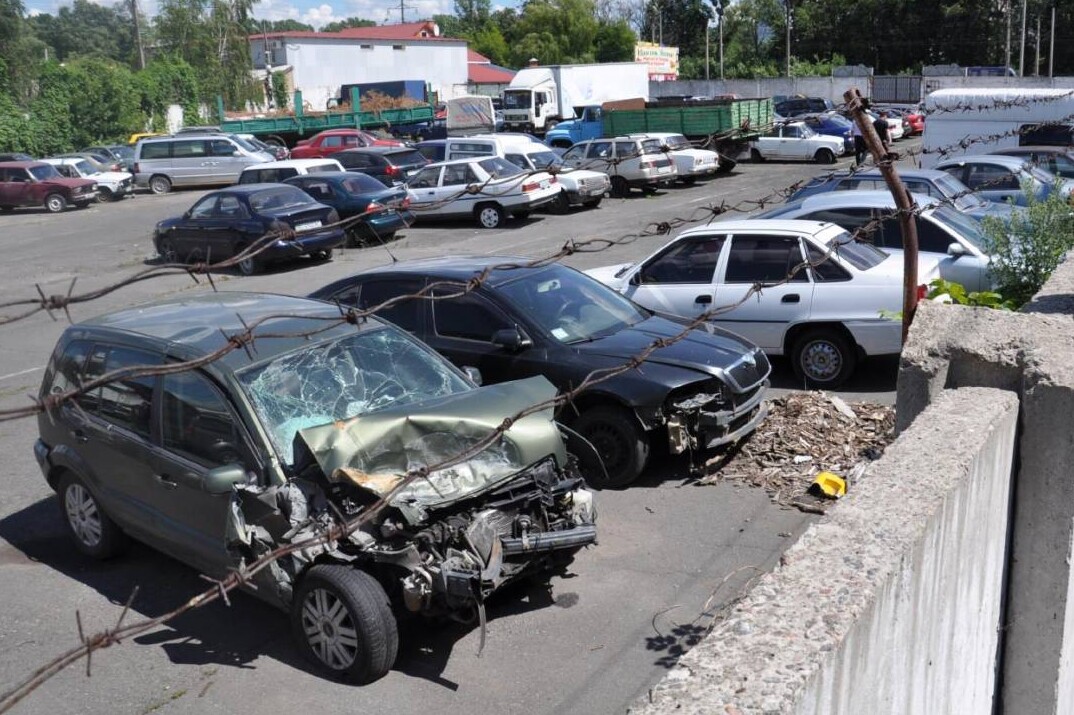 Impound yard. Photo for illustrative purposes from the cheline website
The city has calculated how much this will cost. Initially, the necessary work was estimated at approximately 1.6 million hryvnias. However, this calculation was made before the significant rise in fuel prices, so now, according to the city’s estimate, the costs will exceed 2 million hryvnias.
The plan is to involve several municipal utilities in the development of the site, but there is a problem — the city lacks the funds for this.
«Given that in 2026 the situation regarding the funding of the city’s municipal enterprises responsible for urban improvement works remains difficult, the issue of developing this site—which is not even municipally owned — has been postponed until the city’s financial situation improves», the city council reported.
Therefore, according to the city council, there is no point in purchasing a recovery vehicle to transport abandoned cars to storage without a designated site.
In other words, the document itself has been drafted, but the city council is not yet submitting it for approval, as it will not actually be workable without the other necessary conditions being met.
«The document will only be submitted for approval once funding for the relevant measures has been secured, which is a condition set by the Main Directorate of the National Police in the Mykolaiv region,» the Mykolaiv City Council stated.
How will the towing mechanism work if it is approved?
If all three conditions are met and the «Procedure for the Identification and Removal of Abandoned Vehicles» is approved, it will speed up the «removal» of abandoned cars from the streets, and the city will receive funds following their sale.
According to the document, the vehicle must first be identified and recorded. This can be done by the city council’s district administration during its own inspection of the area or following a report from residents, businesses, organisations or state bodies. The report must specify the address, state how long the vehicle has been unused, and include at least two photographs taken from different angles.
Following this, representatives of the administration will draw up an inspection report and photograph the vehicle. An information sticker with a message for the owner will be placed on the windscreen or, if there is no windscreen, on the bodywork.
The vehicle will then be checked weekly for at least one month. If it remains in the same place, the notice will be re-posted, and the local authority will compile all relevant materials — inspection reports, photographs, residents’ complaints and other documents.
If, after this, the vehicle remains in the same place, it will be referred to a special commission responsible for identifying and removing abandoned vehicles. This commission is to include representatives of the city council, the municipal utility company, the police, the Ministry of Internal Affairs service centre, the patrol police and customs — subject to agreement.
 Municipal workers remove an abandoned car. Illustrative photo courtesy of Lvove City Council
The committee will be able to visit the site, inspect the vehicle and attempt to identify its owner. To this end, enquiries will be made to the relevant authorities and, if necessary, announcements will be made in the media.
If the owner cannot be found and there are grounds for the vehicle to be towed away, the commission will take the appropriate decision. The municipal utility company designated by the city council will then use a recovery vehicle to move the car to a special site or car park, where it will be handed over to the National Police for safekeeping.
The city must publish a notice regarding the removal of the vehicle in the print media or on the city council’s website.
However, the owner will not automatically lose the vehicle. If they, or any other person with a legal claim to the vehicle, contact the police, the vehicle must be returned once the storage costs have been paid.
However, if the owner is not found or does not claim their rights to the vehicle within six months of the notice being published, the vehicle may be sold. The proceeds will be credited to a special bank account, after deducting the costs of storage and sale.
If, within the following three years, the former owner does not claim this money, the proceeds from the sale will become the property of the Mykolaiv City Territorial Community.
You can view the draft document below:
How does this work in other cities?
In some Ukrainian cities, such a mechanism is already in place. For example, in Odesa, this procedure was approved last autumn.
The scheme is similar to the one proposed for Mykolaiv. First, the vehicle is recorded; then, attempts are made to locate the owner; and only after that can the vehicle be towed to a special police impound site.
Residents themselves can report an abandoned car in Odesa — via the city’s contact centre, the police or directly to the relevant department. Once a report is made, a special commission is dispatched to the scene. It inspects the car and checks who it belongs to.
If the owner can be identified, they are sent a notice to remove the car within a week. Administrative proceedings may also be brought for breaches of parking regulations or public order.
If, however, the owner cannot be found, the city conducts further enquiries amongst residents, puts up notices and publishes information about the vehicle on the city council’s website. If, after this, no one claims ownership, the committee may deem the car to be property that the owner has effectively abandoned and recommend that it be removed.
 Vehicle removal in Odesa. Photo: Odesa Patrol Police
In such cases, the vehicle is towed to a special National Police impound site. The city also makes a public announcement to this effect. The owner may still reclaim the vehicle — to do so, they must contact the police and pay the costs of transport and storage.
If, however, the owner fails to come forward within six months of the announcement being published, the car may be sold. The proceeds are initially held in a special account. If the former owner does not claim them within the following three years, they become the property of the local authority.
Moreover, Odesa has already moved from general procedures to practical solutions. On 31 August 2026, the city council’s executive committee declared ten abandoned vehicles to be ownerless and authorised their removal to a special police impound site.