A programme to support internally displaced persons has been developed in Pivdennoukrainsk — a three-year budget of ₴4.5 million has been allocated
- Julia Lukyanenko
-
•
-
18:15, 04 September, 2026
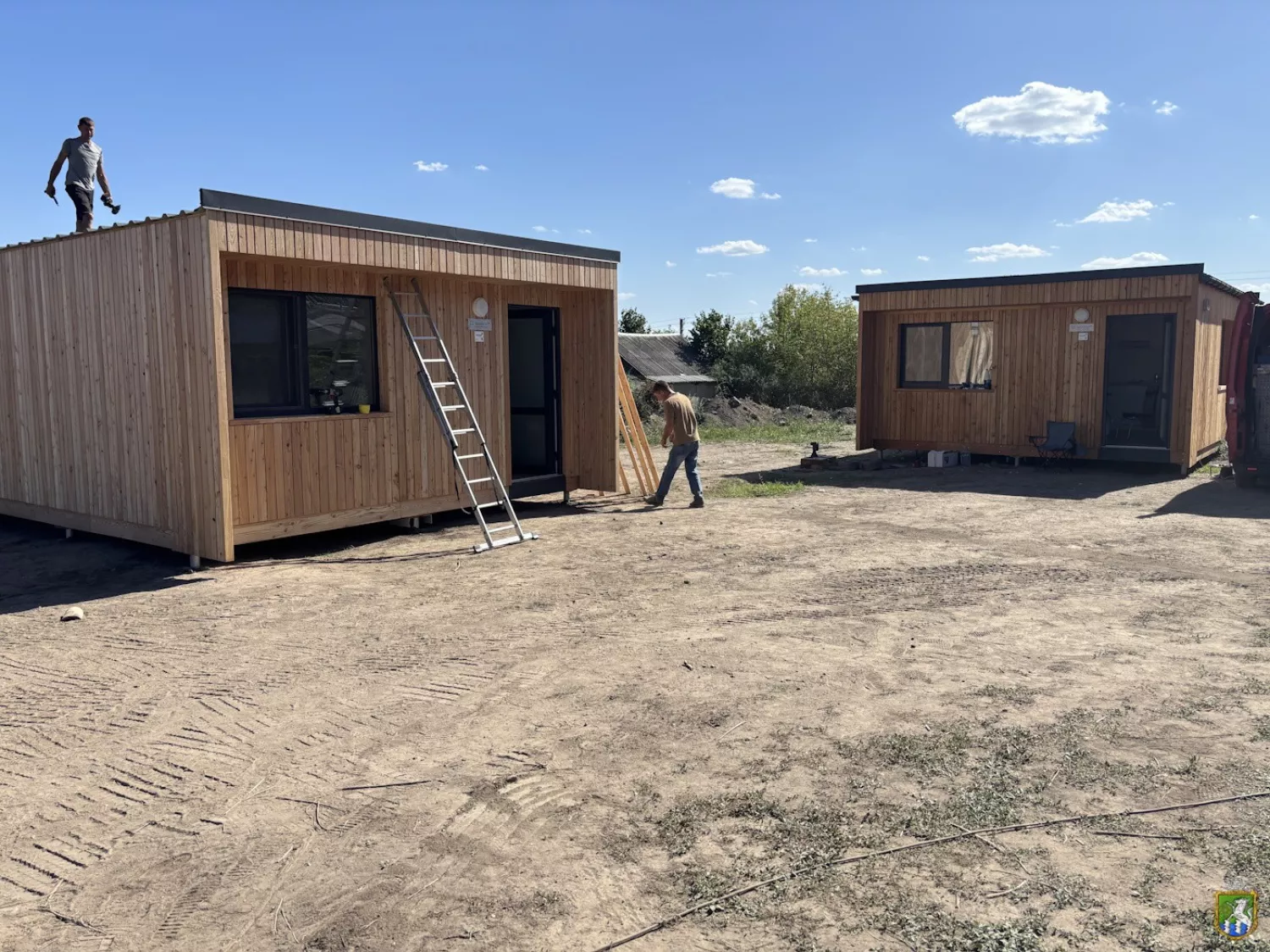 A modular settlement for medical staff who are IDPs in Kostiantynivka. Photo: Pivdennoukrainsk City Council
The Pivdennoukrainsk City Council has drawn up a Comprehensive Programme to Support Internally Displaced Persons. It is proposed that the programme be approved until 2028. The programme identifies the provision of housing as the main challenge, due to a lack of available premises.
This is stated in the draft resolution of the Pivdennoukrainsk City Council.
The draft resolution notes that 3,372 internally displaced persons are registered within the South Ukrainian community. In addition to their integration, housing for them is a separate issue.
«At the same time, assessing the community’s actual needs and capabilities in terms of providing access to housing is significantly complicated by the lack of available residential premises,» the draft resolution states.
It is therefore proposed to introduce a comprehensive programme. The main objectives are to create conditions within the communities to meet the basic needs of IDPs, to ensure their social adaptation at the initial stage, to facilitate their resettlement, and to provide access to psychological support and rehabilitation, healthcare and education.
The programme is to be funded from the budget of the Pivdennoukrainsk community and other sources not prohibited by law. It is planned to allocate funds for this purpose each year when the budget is drawn up.
The programme implementation plan sets out a projected budget for three years. Total expenditure has been allocated at 4.5 million hryvnias:
- Organising compact accommodation for IDPs — 300,000 hryvnias (100,000 per year).
- Carrying out housing repairs — 450,000 hryvnias (150,000 per year).
- Securing international technical assistance and funding from international financial organisations to provide housing for internally displaced persons, with co-financing from local communities — 1.5 million hryvnias (500,000 per year).
- Providing IDPs with social services, social payments and the realisation of their rights and freedoms — 450,000 hryvnias (2026 — 100,000, 2027 — 150,000, 2028 — 200,000).
- Provision of humanitarian aid, clothing, food parcels and hot meals – 450,000 hryvnias (2026 – 100,000, 2027 – 150,000, 2028 – 200,000).
- Financial assistance for IDPs — 450,000 hryvnias (2026 — 100,000, 2027 — 150,000, 2028 — 200,000).
- Health and leisure programmes for children registered as IDPs — 450,000 hryvnias (2026 — 100,000, 2027 — 150,000, 2028 — 200,000).
- Provision of medical care for internally displaced persons in accordance with community programmes – 450,000 hryvnias (2026 – 100,000, 2027 – 150,000, 2028 – 200,000).
The programme also states that the following are planned without community funding, in particular: monitoring and allocation of housing for displaced persons, and participation in grant schemes to set up or expand their own businesses, providing internally displaced persons with medical care in accordance with state-guaranteed healthcare programmes for the population.
Modular homes for IDPs
As a reminder, in 2024, the first modular homes for IDPs began to be installed in Pivdennoukrainsk. It later emerged that the city would need at least 2 million hryvnias to implement this project.
Each of the houses is equipped with centralised water supply and drainage systems, electricity supply, and electric convector heating, according to the city council. Inside, the homes are fitted with essential furniture, sanitary ware and household appliances, ensuring that displaced persons can enjoy a comfortable stay immediately upon moving in.
In April 2025, nine families of internally displaced persons moved into such homes. They were accommodated in homes erected with financial support from the Swiss Association for Aid to Ukrainians, «Help Ukraine».
In April 2026, it emerged that displaced persons living in modular housing estates were unable to apply for the preferential heating tariff available for blocks of flats, due to conflicting legislation. The Mykolaiv Regional Council has raised this issue with the Cabinet of Ministers, as there are already many such settlements in the region.