Deputies were unable to approve Mykolaiv’s budget forecast up to 2029
- Alina Kvitko
-
•
-
17:30, 02 November, 2026
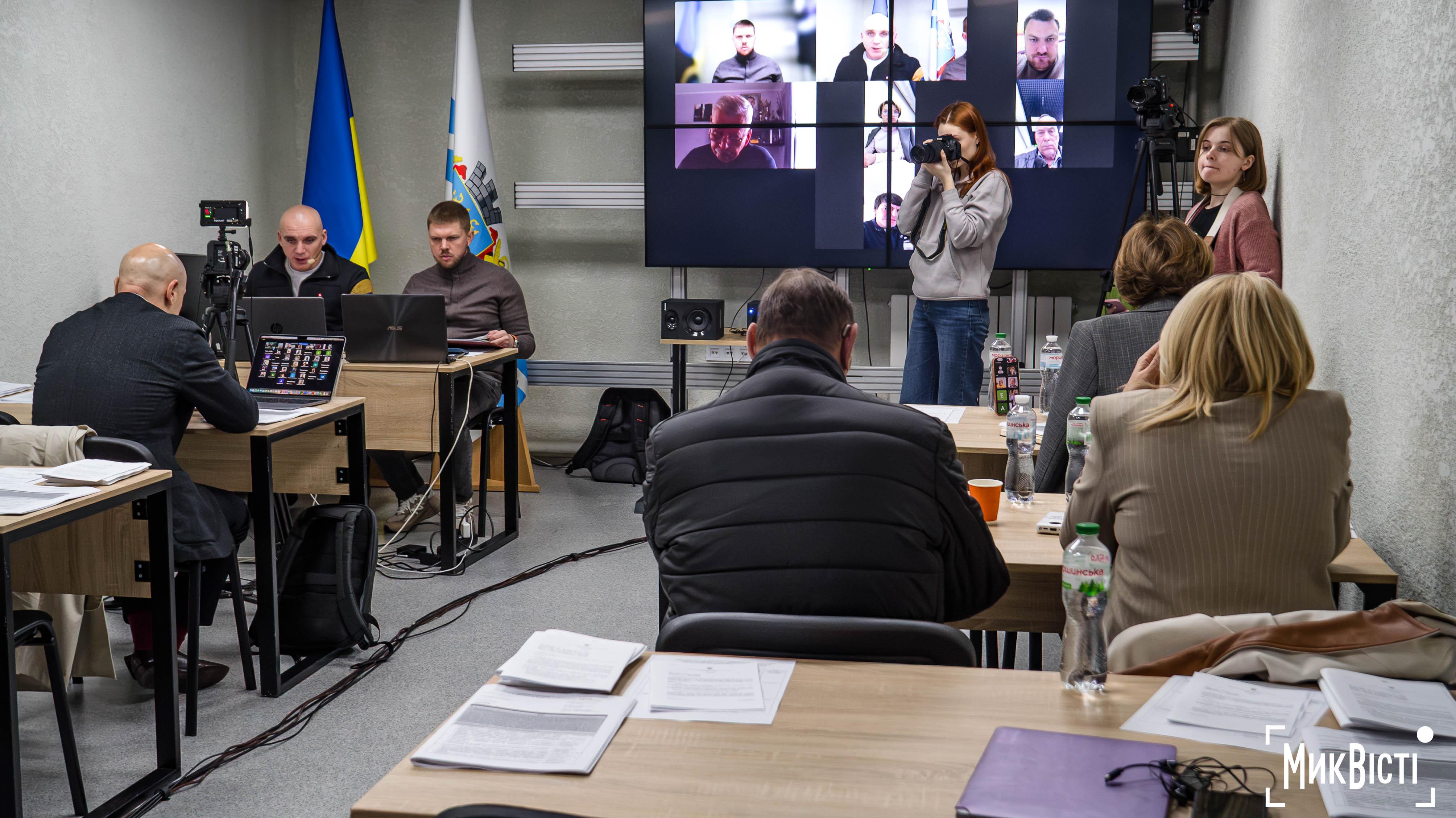 A session of the Mykolaiv City Council, archive photo NikVesti
Councillors on the Mykolaiv City Council failed to approve the local authority’s budget forecast for 2027–2029 after two attempts. The Department of Finance had warned of a funding shortfall, and during the debate, councillors raised issues regarding the funding of municipal utilities, the running costs of the city administration and the fitting out of shelters.
This was discussed during the city council session on 29 October, according to NikVesti.
Presenting the document, Vira Sviatelyk, Director of the Finance Department at Mykolaiv City Council, reported that the city’s financial outlook remains challenging.
«Unfortunately, they are not very positive. We have once again updated our forecast for the next two years and, regrettably, this forecast indicates that the Mykolaiv City Territorial Community lacks sufficient funds to ensure the sustainable, high-quality functioning of our community,» said Vira Sviatelyk.
According to the draft budget forecast, Mykolaiv’s revenue, taking into account inter-budgetary transfers, is expected to reach 5.67 billion hryvnias in 2027. In 2028, this figure was expected to be 6.27 billion, and in 2029, 6.88 billion hryvnias.
Expenditure for these years was forecast at 5.06 billion, 5.57 billion and 6.21 billion hryvnias respectively. The city planned to derive most of its revenue from personal income tax. However, as Vira Sviatelyk explained, the situation is complicated by the fact that the city no longer expects the return of military personal income tax to the local budget. The previous forecast had anticipated that these revenues would resume from 2027, but such expectations no longer exist.
«Last year, medium-term planning was reinstated and it was so optimistic for the city of Mykolaiv, as it stated that in 2027 we would have the military personal income tax returned to us, and we were set to see significant progress in revenue from 2027 onwards. Unfortunately, it turned out that this was only on paper. And so this year we have a realistic forecast based on actual funds,» explained Vira Sviatelyk.
According to her, personal income tax from military personnel could have brought Mykolaiv around three billion hryvnias.
«There is no longer any hope of the military personal income tax being returned. Around three billion hryvnias could have been used for the city’s sustainable development. But these funds are not available. Therefore, we must work within the limits of the resources we currently have,» added Vira Sviatelyk.
The draft forecast itself sets out, amongst the budgetary policy objectives for the coming years, the need to achieve savings in budgetary funds and to review expenditure.
«Improving the effectiveness and efficiency of budgetary expenditure by applying effective methods of saving budgetary funds, optimising the expenditure of the main budget administrators by eliminating non-priority and inefficient expenditure, and further optimising budgetary programmes,» the document states.
The forecast also notes that the city’s finances will remain dependent on the security situation, the performance of businesses, population migration, inflation and changes to tax legislation.
During the discussion, Olena Kiselova, a councillor on the Mykolaiv City Council, questioned the effectiveness of budget spending in 2026, particularly on support for municipal utilities.
«We have essentially made this year’s budget a budget for a rosy future for municipal utilities. I would like to hear how effective this has proved to be,» said Olena Kiseliova.
Separately, the councillor drew attention to the lack of civil defence shelters in the city. She asked whether the budget included funds for the purchase and repair of shelters, given that the forecast mentions many projects for Mykolaiv’s future development.
«I’m curious whether we have the resources to purchase and repair air-raid shelters, because today this is, well, a major issue, but we’re somehow getting by,» noted the councillor.
Olena Kiseliova also asked the finance department to prepare comparative data on expenditure for municipal utilities, the city council’s executive bodies and budgetary institutions. She proposed comparing the planned and actual expenditure for 2026 with the forecast for subsequent years.
During the discussion, councillor Serhii Kantor drew attention to a possible increase in expenditure on the running costs of the city council’s executive bodies. According to the figures he cited, these costs amounted to 219 million hryvnias in 2026, whilst the forecast for 2027 stood at 284 million hryvnias — an increase of approximately 29 per cent.
«I would like to see the rationale for the increase in expenditure on the executive committee, particularly on staff costs,» said Serhii Kantor.
He also proposed verifying discrepancies in economic and budgetary indicators, providing a justification for the tax revenue forecast, and drawing up an action plan in case the city fails to receive the planned revenue.
In contrast, councillor Fedir Panchenko called on his colleagues to support the document, emphasising that refusing to approve it would not change the community’s actual financial situation.
«Arguing about the budget forecast is like arguing about the weather forecast. It will be what it will be. And even if we were to redraw this forecast for ourselves, the situation won’t change tomorrow. I propose we support this technical decision, which will allow us to continue working on the budget,» said Fedir Panchenko.
During the discussion, City Council Secretary Dmytro Falko also emphasised that municipal enterprises ensure the city’s essential services and therefore require funding.
«If we do not fund the municipal utilities, we will have no one to clean the streets, provide heating, collect rubbish or transport residents. Expenditure must be rational. Another issue is that we need to analyse where these funds have gone,» noted Dmytro Falko.
Councillor Oleksandr Bereza proposed strengthening financial oversight of the work of municipal enterprises not only at the end of the year, but throughout the entire budget period.
«Efficiency must be monitored throughout the year: what the funds are spent on, what the accounts payable and receivable are, what assets have been acquired, and what the administrative costs are,» said Oleksandr Bereza.
Following the discussion, the document was put to a vote. Twenty-five councillors voted in favour of its adoption, one voted against, and eight abstained. The motion was not passed.
Immediately after the first vote, Councillor Tetiana Dombrovska proposed organising a separate working meeting with the heads of municipal utilities to hear a report on their performance for the first seven to nine months of 2026.
Following this, Olena Kiseliova proposed a second vote on the budget forecast.
«The forecast must be adopted. This is really a technical decision. Let’s try putting it to a second vote,» said Olena Kiseliova.
However, the second attempt also proved unsuccessful. Twenty-four councillors voted in favour of the document, seven abstained, and there were no votes against.
As a reminder, NikVesti previously investigated why Mykolaiv is short of budget funds and why payments are being delayed. In early October, the city appealed for the third time to the Verkhovna Rada and the Cabinet of Ministers, requesting an additional 819.1 million hryvnias for priority needs until the end of 2026.
The greatest shortfall was in funding for water supply and heating — 412.7 million hryvnias. A further 138.8 million hryvnias were needed for salaries for staff at state-funded organisations, 106.3 million for utilities, and 96.7 million for passenger transport by electric trams.
Furthermore, since mid-September, the Treasury has been withholding some payments from the city budget. As of 12 October, invoices totalling over 370 million hryvnias remained unpaid. As a result, the city was unable to pay on time for some of the work and services already carried out.
It was also previously reported that the main budget administrators had been unable to identify any expenditure that could be cut. Despite a request from the mayor, Oleksandr Sienkevych, to review expenditure for the last two months of the year, they stated that funding of approximately 800 million hryvnias was required.