Water chlorination in Mykolaiv: the chief medical officer explained what the test results show
- Julia Lukyanenko
-
•
-
19:10, 02 November, 2026
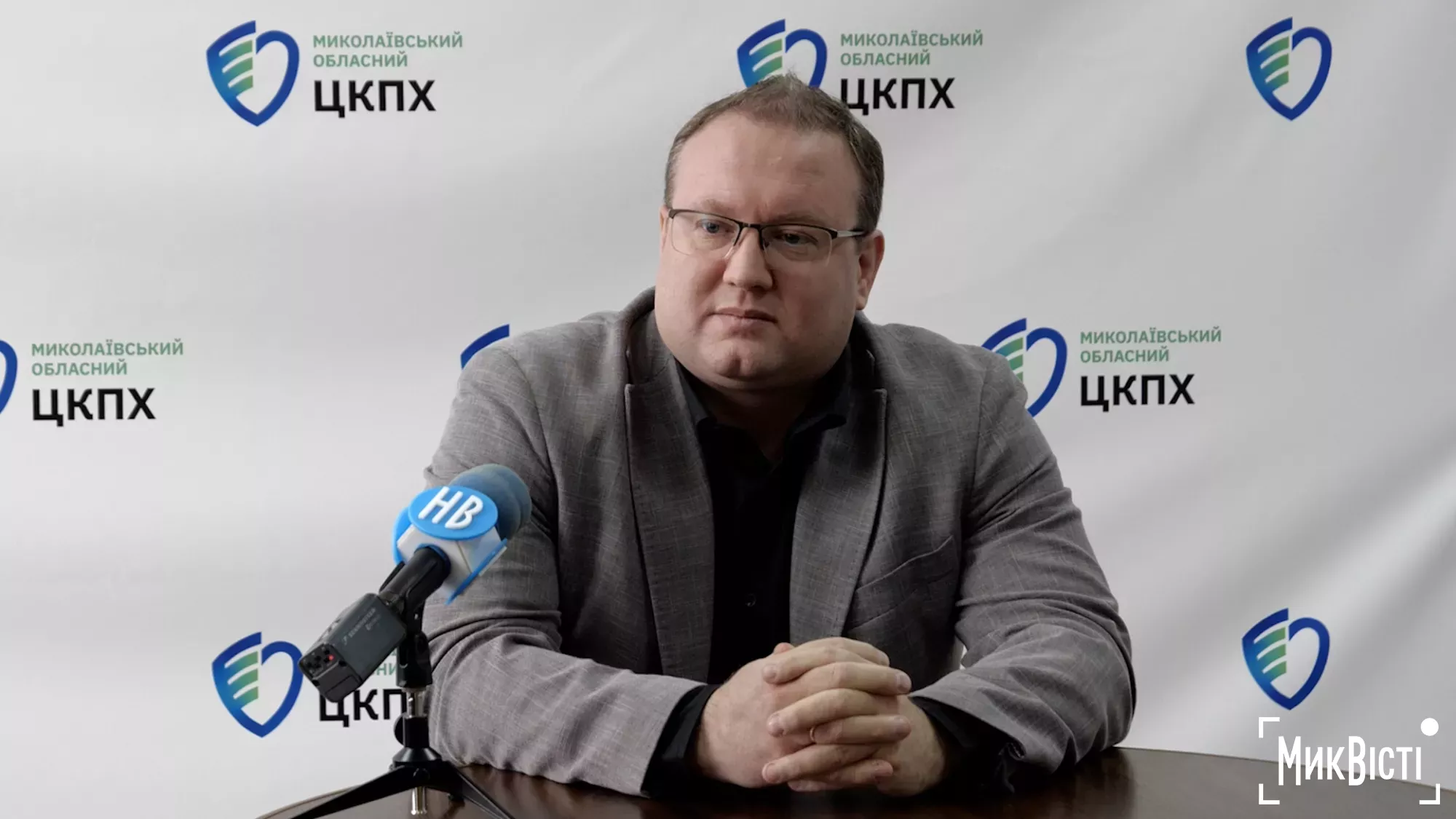 Dmytro Makarov, chief medical officer for the Mykolaiv region, explained which water quality standards had been exceeded. Photo: NikVesti
From Monday, 2 November, «Mykolaivvodokanal» began additional chlorination of the water. The company reported that the process was expected to last between two weeks and three months.
NikVesti spoke to Dmytro Makarov, Chief State Sanitary Doctor of the Mykolaiv region, to find out which water quality standards had been exceeded and whether there were any risks to residents from using chlorinated water.
Water quality monitoring
Dmytro Makarov noted that, in addition to the state bodies responsible for monitoring, «Mykolaivvodokanal» checks water quality on a daily basis. The remit of the Mykolaiv Regional Centre for Disease Control and Prevention of the Ministry of Health of Ukraine is the state monitoring of drinking water and the drinking water supply.
During 2026, the centre analysed over 350 water samples from Mykolaiv’s water networks. Sanitary-chemical and microbiological parameters were tested.
Exceedances
Samples were taken at random from monitoring points. The Regional Centre for Disease Control and Prevention took samples from the internal water supply networks of healthcare facilities. There were 10 monitoring points in various districts of Mykolaiv.
«A certain number of samples were found to deviate from the standards, both in terms of sanitary-chemical parameters and epidemic safety indicators. The sanitary and chemical parameters in question were turbidity, colour, total iron and permanganate oxidisability. In terms of epidemiological safety indicators, there were deviations in the total microbial count in 72 samples, total coliforms in 80 samples, and enterococci were detected in four samples,» said Dmytro Makarov.
He clarified that there are four key water quality indicators. Three of these exceeded the standards.
«There are four key indicators used for monitoring. And deviations were found in three out of the four. These are the total microbial count, total coliforms and enterococci,» noted Dmytro Makarov.
The Centre for Disease Control and Prevention has forwarded the monitoring results, in particular to the water utility, for further action. However, the Centre does not provide approval or authorisation for chlorination.
«Our task is to present the results of the laboratory tests. In other words, the results have been forwarded, whilst technical decisions regarding specific measures are taken directly by the operator responsible for the particular water supply system. The results of our monitoring have been forwarded to the executive authorities, local government bodies and the drinking water supply company for further action,» said the Chief Medical Officer of the Mykolaiv region.
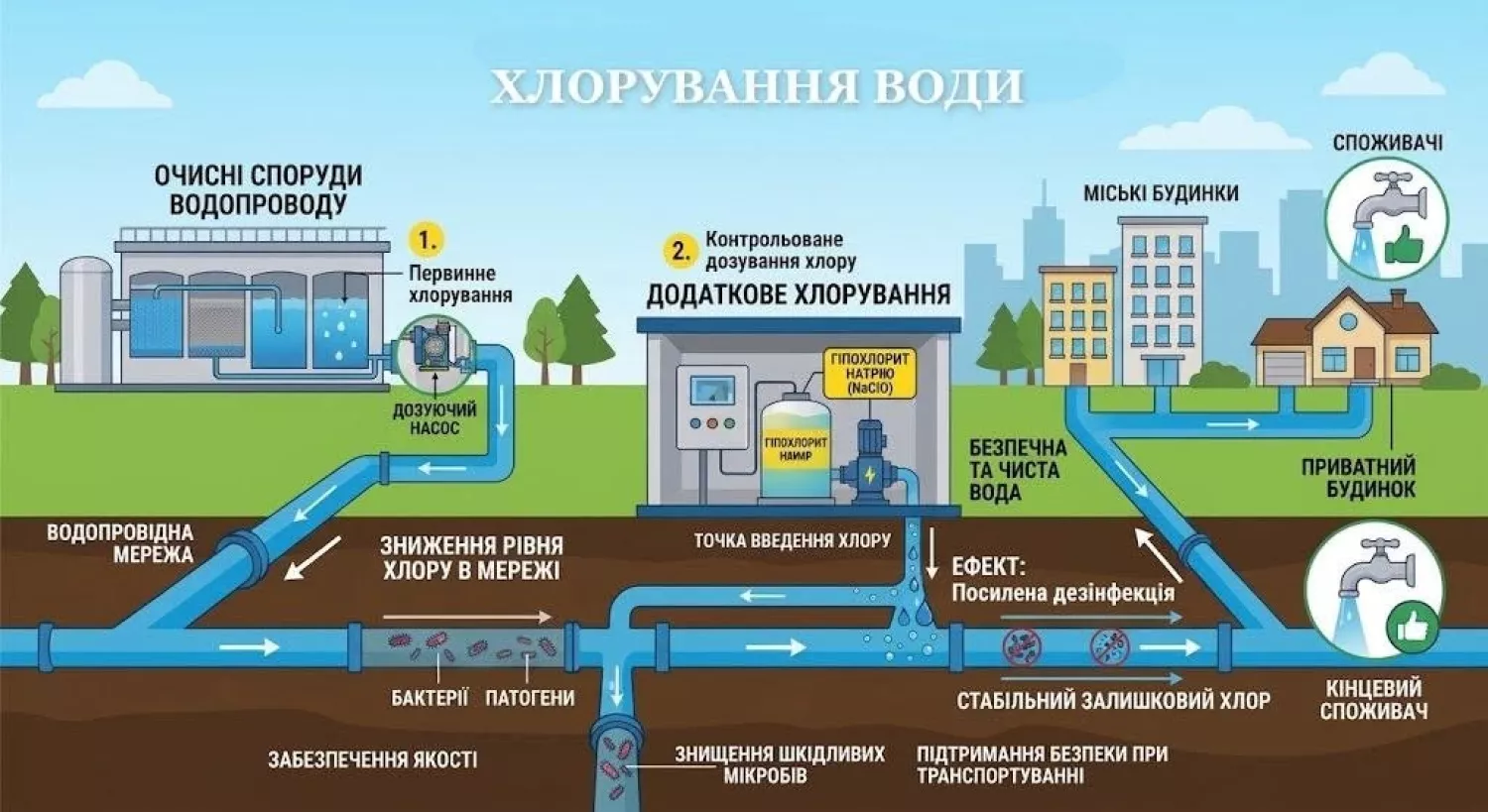 How chlorination will be carried out. Infographic by Mykolaivvodokanal
Risks of chlorination
At present, residents of Mykolaiv have raised concerns about the risks of using chlorinated water, particularly for domestic purposes. According to the Chief Medical Officer of the Mykolaiv region, if the water utility maintains a residual chlorine concentration of 0.3–0.5 mg/l, the risks will be minimal.
«What would I base my risk assessment on? It would be the levels of residual free chlorine in the water supply network. From the reports we have received from the Mykolaivvodokanal Municipal Utility Company, despite the increased dose of chlorine intended for water disinfection at the water treatment plants, the plan is to bring the concentration of residual active chlorine down to the standard levels of 0.3–0.5 mg/l of water. Therefore, if this concentration is indeed maintained and the water enters the mains supply, the risks will be minimal,» said Dmytro Makarov.
The risk assessment regarding water chlorination has been forwarded to the water utility and the city council. As Dmytro Makarov noted, the potential risks associated with an elevated concentration of chlorine in drinking water are linked to its irritant effect.
«The recommendations for the public were to limit time spent in enclosed spaces whilst using hot water, to monitor the condition of their skin, and under no circumstances to use the water for drinking, but only for domestic purposes,» said the chief medical officer.
Whether to let the water stand, as recommended by the water utility and the Centre for Disease Control and Prevention, also depends on the concentration of residual chlorine in the water.
«If we’re talking about letting the water stand as a temporary method to improve water quality, perhaps, but again, we come back to the fact that it may not be necessary if the concentrations do not exceed the established limits,» added the chief medical officer.
 Risk assessments regarding chlorination have been submitted to the water utility and the city council. Illustrative photo: NikVesti
Final conclusions can be drawn once the concentration of residual active chlorine in the network is known.
«If it falls within the limits set out in the sanitary standards and regulations, then, in principle, the risks will be minimal. «As regards the use of water in general for domestic and drinking purposes, we naturally recommend water of guaranteed quality, provided it meets the requirements of current sanitary standards and regulations,» said Dmytro Makarov.
The Centre for Disease Control and Prevention will continue, as before, to monitor the quality of drinking water from the Mykolaiv mains supply. Tests are also being carried out by the water utility’s laboratories and the State Service for Food Safety and Consumer Protection. The first samples have already been taken for testing of sanitary-chemical and microbiological parameters.
«When it comes to the concentration of free chlorine in the water, this is regulated and standardised at the outlet of the treatment works. This is part of the monitoring carried out by the Mykolaivvodokanal Municipal Utility Company, and they are required to monitor this parameter daily, immediately before the water enters the mains supply,» noted the chief medical officer.
The water problem in Mykolaiv
In June, the mayor of Mykolaiv, Oleksandr Sienkevych, reported that despite improvements in water quality following the commissioning of new treatment works and a water pipeline, it is not yet advisable to drink tap water.
On 2 October, the acting head of the Mykolaiv Regional Military Administration, Heorhii Reshetilov, announced plans to treat the water supply system using chlorination and hyperchlorination. As noted, the work is expected to last approximately three months, during which time the water cannot be used for drinking or cooking.
At a staff meeting on 5 October, Mayor Oleksandr Sienkevych stated that, in Mykolaiv, the water meets drinking water standards after passing through the treatment works. However, according to test results, in 46 per cent of samples taken at monitoring points across the city, water quality deteriorates and bacterial contamination is detected. The water utility attributes this to the length of the network: over 1,200 km of pipes that have been carrying salt water for three years.
Subsequently, the water utility announced that chlorination would begin on 2 November.
The company’s chief engineer, Vitalii Tkachenko, told journalists that the chlorine dose would be «slightly higher than usual». The additional chlorination is being carried out to flush the city’s water networks, to eliminate «microbiological contamination» that exceeds the standards, and to supply residents with drinking water.