Fewer breakdowns and less reliance on the mains: how Pivdennoukrainsk plans to modernise its sewerage system with funding from Denmark
- Yuliia Boichenko
-
•
-
07:00, 03 November, 2026
 Construction work in the Mykolaiv region. Photo from the «NikVesti» archive, used for illustrative purposes
The entire sewerage system in Pivdennoukrainsk relies on two pumping stations and a pipeline through which the town’s wastewater flows through the system. This infrastructure has been in operation for around 40 years. The local water utility says the equipment requires constant repairs, and the pipeline itself has sprung leaks on numerous occasions. Plans are now in place to upgrade the infrastructure with funding from Denmark, with the project to be implemented by NEFCO — the Nordic Environment Finance Corporation.
NikVesti investigated what will change for residents, how the sewerage system will operate during construction, and when completion can be expected.
What the city will get for €5.8 million
Sewage pumping stations transfer wastewater where it cannot flow by gravity. The pumps feed it into a pressure main — a pipeline that carries the effluent to the next section of the sewerage system.
In Pivdennoukrainsk, there are plans to refurbish two such stations and build a new collector, the local utility company «Heating, Water and Sewerage Services» told NikVesti.
«The drainage of the whole of Pivdennoukrainsk depends on the operation of these facilities,» they added.
Both sewage pumping stations have been in operation for around 40 years, the company added. The pumps and equipment that trap debris from the wastewater will be replaced. The internal pipes, ventilation and power supply will be upgraded.
To reduce the stations’ reliance on the mains electricity supply, the project includes solar panels and batteries. The panels will generate electricity, whilst the batteries will store it for later use. If the system is configured for backup power, the stored energy will be able to keep the equipment running during power cuts.
A separate part of the work involves the construction of a pressure sewer. According to the deputy mayor, Mykola Pokrova, the current pipeline has leaked on numerous occasions and required emergency repairs. At present, the damage to it poses a risk of untreated effluent entering the soil, groundwater and the Southern Bug river basin.
«Wastewater is currently being pumped through a single pressure sewer, which is periodically repaired,» the municipal utility clarified.
An automated control and monitoring system — SCADA — will be installed for staff. It collects data from sensors and transmits it to the operator’s screen. This allows staff to view, for example, the wastewater level and the condition of the pumps, and to control the equipment from their workstation.
The practical purpose of this equipment is to help identify problems before they lead to a shutdown or overflow. NEFCO expects that monitoring and automation will provide «the ability to detect and respond to emergencies more quickly».
In total, the project will cost 5.8 million euros. Around 5.2 million euros comes from a grant from Denmark. The local authority is to contribute at least a further 585,000 euros.
«The entire project budget will be allocated exclusively to its implementation and will cover the necessary equipment, works and services,» NEFCO stated.
According to Mykola Pokrova, the city’s contribution is planned to be spread across the 2027 and 2028 budgets.
«As the project is expected to take two years to complete, this budget expenditure will be spread over two years,» he said.
The grant was on hold for half a year whilst the city council convened for a session
Before signing the agreement, the city had to approve its participation in the project and determine who would sign the documents. However, the sessions were postponed from February 2026.
The city council failed to pass a resolution by the deadline of 15 June. As a result, Pivdennoukrainsk was unable to sign the agreement at the conference on Ukraine’s recovery in Gdańsk, and the city faced the risk of losing €5.2 million in grant funding.
However, following negotiations with NEFCO, Pivdennoukrainsk was granted more time and the deadline for making a decision was extended. It was not until 3 July that councillors approved the signing of the grant agreement.
The agreement itself was signed by the parties in August. At the session on 29 October, councillors supported its implementation. These are separate decisions: in the summer, the council authorised the signing of the agreement, whilst the current vote concerns a document that has already been signed.
«The process of obtaining the necessary approvals from the city council did not affect the timing or terms of the project’s funding,» NEFCO told NikVesti.
 building of the Pivdennoukrainsk City Council. Photo: «NikVesti»
Work is expected to begin in 2027. When will the new sewerage system be commissioned?
NEFCO expects work to begin in July–September 2027. Prior to this, procurement must be carried out, a detailed design prepared, an environmental impact assessment conducted and permits obtained.
«The project itself is expected to take approximately three years to complete,» they added.
Contractors and suppliers will be selected in accordance with NEFCO’s procedures. The project implementation team and an independent international consultant will oversee procurement, contract management and construction supervision. NEFCO will be responsible for overall coordination and supervision.
«The construction and commissioning phase is preliminarily estimated to take 16–18 months. Therefore, under certain circumstances—one of the main factors being the actual start date of works—the project’s implementation may be extended into the first or second quarter of 2029. We hope that this will not be necessary,» said Mykola Pokrova, Deputy Mayor of Pivdennoukrainsk.
 A water utility crew at the site of a burst pipe in Mykolaiv, August 2024. Photo from the «NikVesti» archive, used for illustrative purposes
There is currently no precise, agreed launch date for the upgraded system. The next steps are procurement and detailed design. These should provide answers to practical questions: when and in what order the equipment will be replaced, how wastewater will be diverted during installation, and how long the stations will be able to operate without mains electricity.
Will it be possible to use the sewerage system during the repairs?
The sewerage system will continue to operate whilst the new main is being built. Wastewater will be channelled through the old pipe, whilst the new one will be laid separately, explained the municipal utility «Heat Supply and Water and Sewerage Services».
«The new pressure sewer will be laid independently of the existing one, so the existing sewer will not be shut down whilst construction work is underway,» the company stated.
However, there may be interruptions whilst equipment is being replaced at the pumping stations. The company has warned of a brief interruption to the drainage service, but has not specified how long this will last. Nor did they explain whether residents will need to use less water during this time.
According to Deputy Mayor Mykola Pokrova, the works must be organised in such a way that the stations continue to serve the city. How exactly this will be achieved whilst the pumps are being replaced will be determined by the designers.
 Pivdenoukrainsk, Mykolaiv region, photo from open sources
They must plan where to divert the effluent whilst some of the equipment is out of service, and in what order to connect the new pumps and pipes.
«The designer must develop detailed design solutions and technical documentation: it is there that the sequence of pump replacement, the switching of pipelines, temporary wastewater discharge schemes and permissible interruptions must be specified, which must not affect the quality of services provided to the public or the environmental condition around the reconstruction sites,» he said.
Therefore, there are no plans to shut down the sewerage system whilst the new collector is being laid. As for the work at the treatment plants, there is no final decision yet: the company allows for a brief shutdown, but its duration and any potential restrictions for residents will be determined during the design phase.
How much electricity will be saved
Following the refurbishment, the stations are expected to consume approximately 30 per cent less electricity, according to the municipal utility «Heat Supply and Water and Sewerage Services». They forecast that annual consumption following the upgrade will amount to 1,043 megawatt-hours.
At the same time, NEFCO expects that the stations will require around 94 per cent less electricity from the external grid — 90 megawatt-hours per year instead of the current 1,512. The corporation plans to achieve this result through new equipment, solar panels and batteries.
In fact, according to NEFCO’s forecast, the stations will draw less electricity from the grid, as their own solar panels will generate part of the energy required.
However, the volume of solar generation has yet to be finalised, according to the local company.
«The exact amount of electricity generated by the solar panels will be determined during the project development phase,» they said.
 «NikVesti»Solar panels installed on the roof of a high-rise building in Mykolaiv. Photo: «NikVesti»
And what have other cities managed to achieve?
A similar project was carried out in Khmelnytskyi. There, the refurbishment of three sewage pumping stations was completed in 2024. According to the city council, after replacing the old equipment, electricity savings of 27 per cent were recorded as early as 2023. Once fully operational, savings of up to 30 per cent were expected. The mayor, Oleksandr Symchyshyn, mentioned this in a statement announcing the completion of the project.
In Chortkiv, in the Ternopil region, the output of solar panels at three water utility sites has already been calculated. According to the city council, over 12 months they generated 455.22 megawatt-hours of electricity and met a quarter of these facilities’ total consumption. The reported savings amounted to around 3.7 million hryvnias.
These results cannot be automatically extrapolated to Pivdennoukrainsk: the cities have different equipment, requirements and solar station capacities. However, they demonstrate the data that can be obtained once the system is operational: actual electricity consumption, the volume of self-generated electricity and monetary savings.
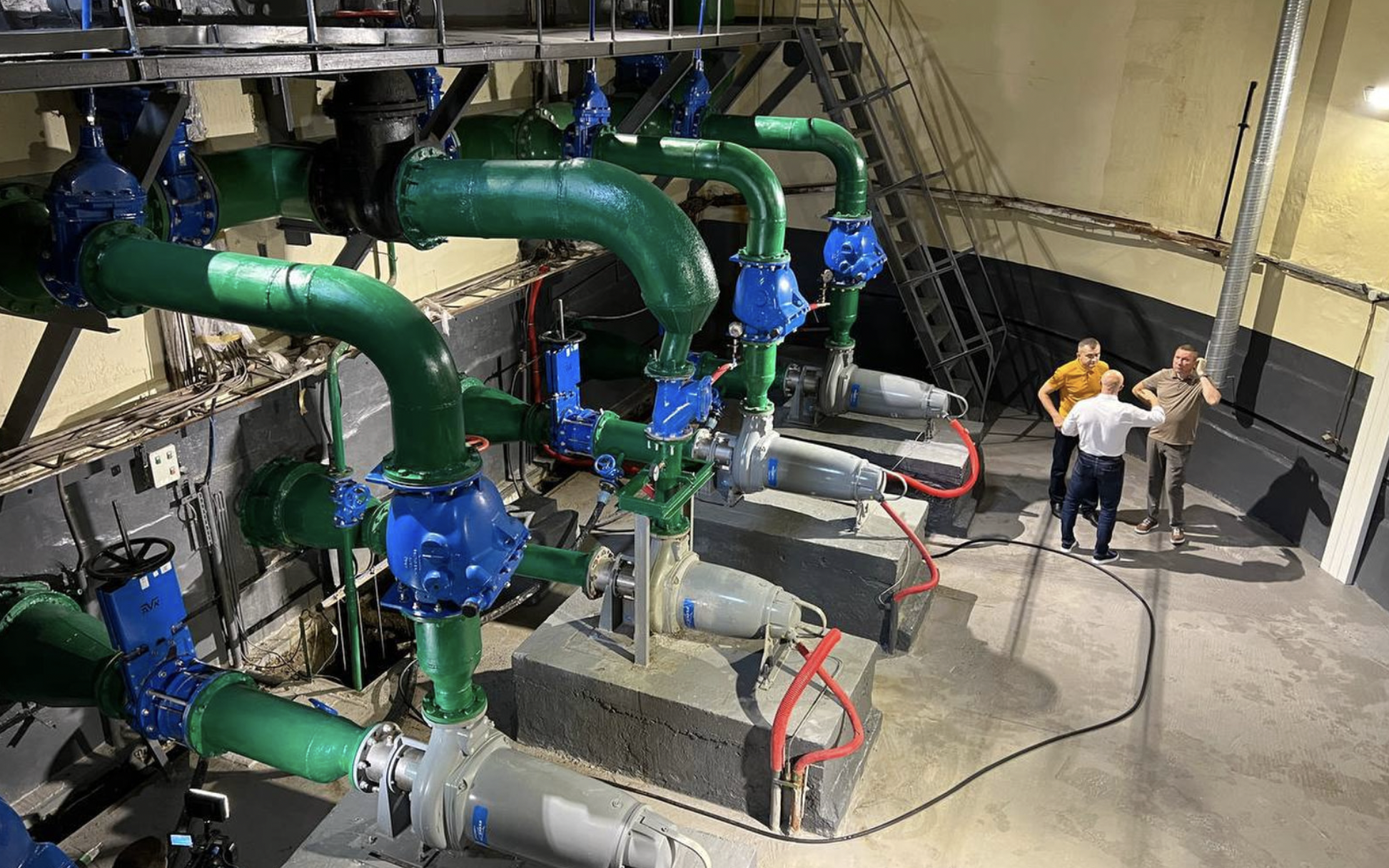 Project to refurbish three sewage pumping stations in Khmelnytskyi. Photo: City Council
For Pivdennoukrainsk, this project offers an opportunity to replace equipment that the city is currently forced to repair constantly. According to the utility company, the entire city’s drainage system depends on two of these pumping stations, whilst the worn-out sewer main poses a risk of sewage leaks. Therefore, the main expected outcome of the refurbishment is more reliable operation of the sewerage system. Electricity savings and on-site power generation should help to maintain the system at a lower cost, even during power cuts.
The process of securing the grant has shown that such an upgrade requires both donor funding and timely decisions by the local authorities. Despite the postponement of council meetings, funding has been secured: NEFCO reports that the delays have not affected its terms and conditions. The local authority must now secure its contribution, and during the design phase it will be necessary to determine how to replace the equipment without leaving the town without a sewerage system.
Work is expected to begin in 2027, so until the upgraded system is operational, the town will continue to rely on the existing stations and pipework. The project’s success will be judged by whether the number of breakdowns has fallen, by how much electricity consumption has been reduced, and by how the stations perform during power cuts. But for now, these are still expected outcomes.
Yuliia Boichenko, NikVesti