Reconstruction outside Prozorro: how transparent are international tenders for Mykolaiv?
-

- Yuliia BoichenkoReporter
-
 20000 +
Incredible! This content has reached a new level — 20,000+ views!
20000 +
Incredible! This content has reached a new level — 20,000+ views!
-
 Prefer on Google
-
20K
Incredible! This content has reached a new level — 20,000+ views!
-
Prefer on Google
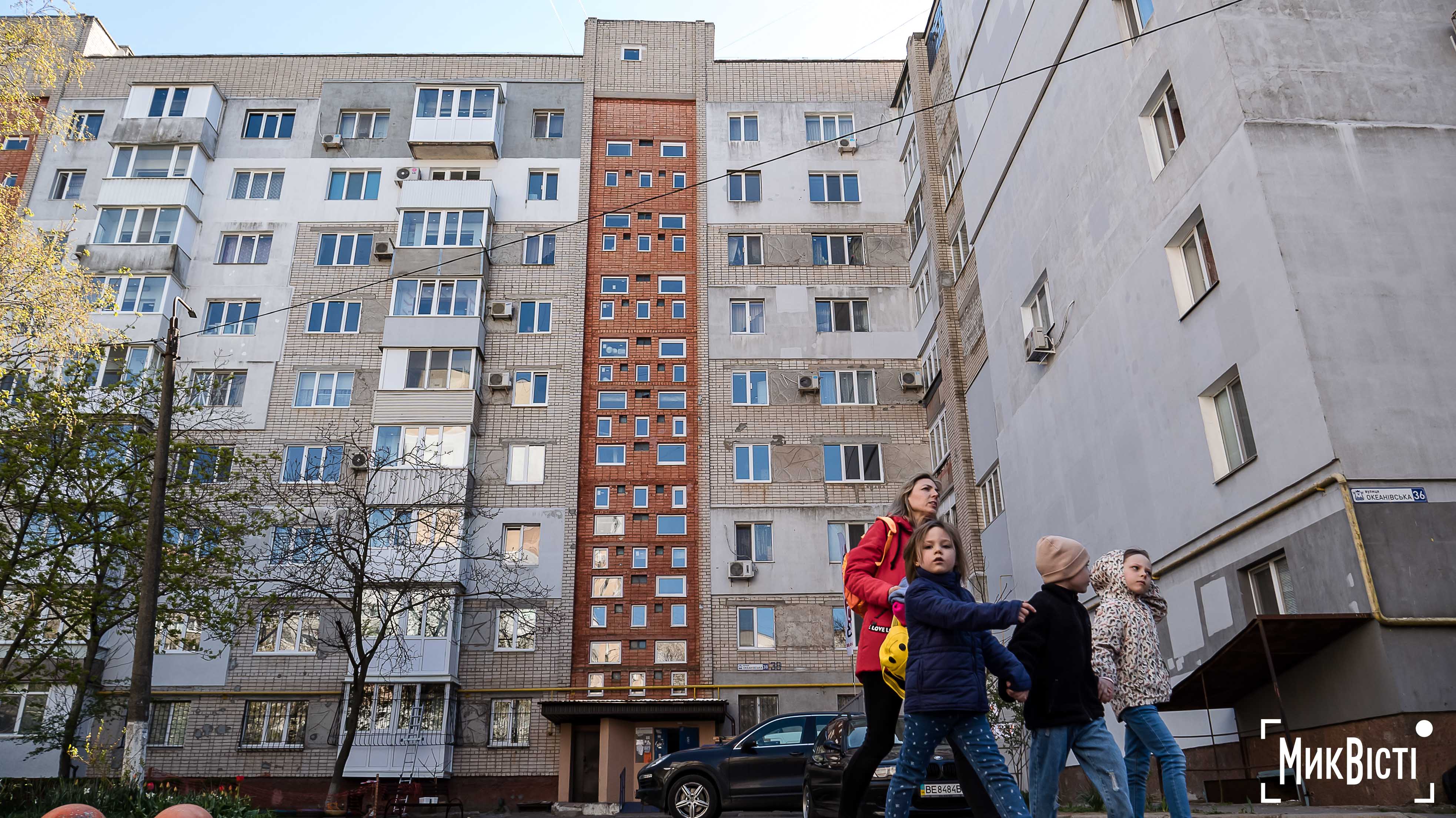 Renovated windows and balconies in one of the residential buildings in the Korabelnyi district, April 2025, photo: NikVesti
Imagine: a building in your neighbourhood is due to be renovated or a new water tower installed. The project is funded by international donors. The work costs millions of hryvnias.
But where can you find out who won the tender? Who submitted bids? And is it really possible to check how this money is being spent?
If it’s a public procurement in Ukraine, the answer is simple: just visit the Prozorro platform. There you can see the contracting authority, the tender participants, their bids and the winner. With international projects, things are more complicated. Often, such procurements do not go through Prozorro, but through the platforms of international organisations — for example, those of the UN, NEFCO or the World Bank.
How transparent are international tenders, and can an ordinary community member check how donor funds are being spent?
NikVesti investigated this using the example of several procurements in the Mykolaiv region.
How do purchases take place via Prozorro?
Denmark is currently the largest international donor to the Mykolaiv region, with its government allocating funds for projects in the region. However, this funding does not go through local authorities but via international partner organisations, Jakob Hansen, head of the Danish Embassy’s office in Mykolaiv, told NikVesti.
«We never hand over money directly to the Ukrainian side,» he noted.
In fact, the process is simple: the Danish government allocates funds for a particular project in Mykolaiv or the region, and a partner organisation is responsible for its implementation. These are international organisations, financial institutions and humanitarian non-governmental organisations that implement projects on the ground.
 Jacob Hansen, Head of the Danish Embassy Office in Mykolaiv, at the opening of the UN Development Programme office in the city. Photo: ‘NikVesti’
Among these partner organisations are the United Nations Office for Project Services (UNOPS) and the Nordic Environment Finance Corporation (NEFCO). It is they who issue tenders in accordance with international standards, seek out contractors, and monitor the quality of work carried out or equipment procured.
Donors do not decide on their own what the city or region actually needs. A partnership steering committee has been set up for this purpose, says Jacob Hansen. It comprises representatives of the regional and city authorities, as well as the Danish government.
«There is a partnership steering committee comprising Vitalii Kim (head of the Regional State Administration, — note), Anton Tabunschyk (chairman of the regional council, — note), Oleksandr Sienkevych (mayor, — note) and our Minister of Foreign Affairs,» noted Jacob Hansen.
Meetings — known as Project Board meetings — are held several times a year for each project. These bring together representatives from the Danish Ministry of Foreign Affairs, the embassy, and procurement experts from partner organisations. During these meetings, the parties discuss requests received from the city and the region.
«There we discuss what needs to be procured. And based on the outcomes of the Project Board, a tender is launched. All procurements carried out within the framework of Denmark’s partnership with Mykolaiv are open. It’s just that this takes place on different platforms, because different international organisations are involved,» explained the head of the Danish Embassy’s office in Mykolaiv.
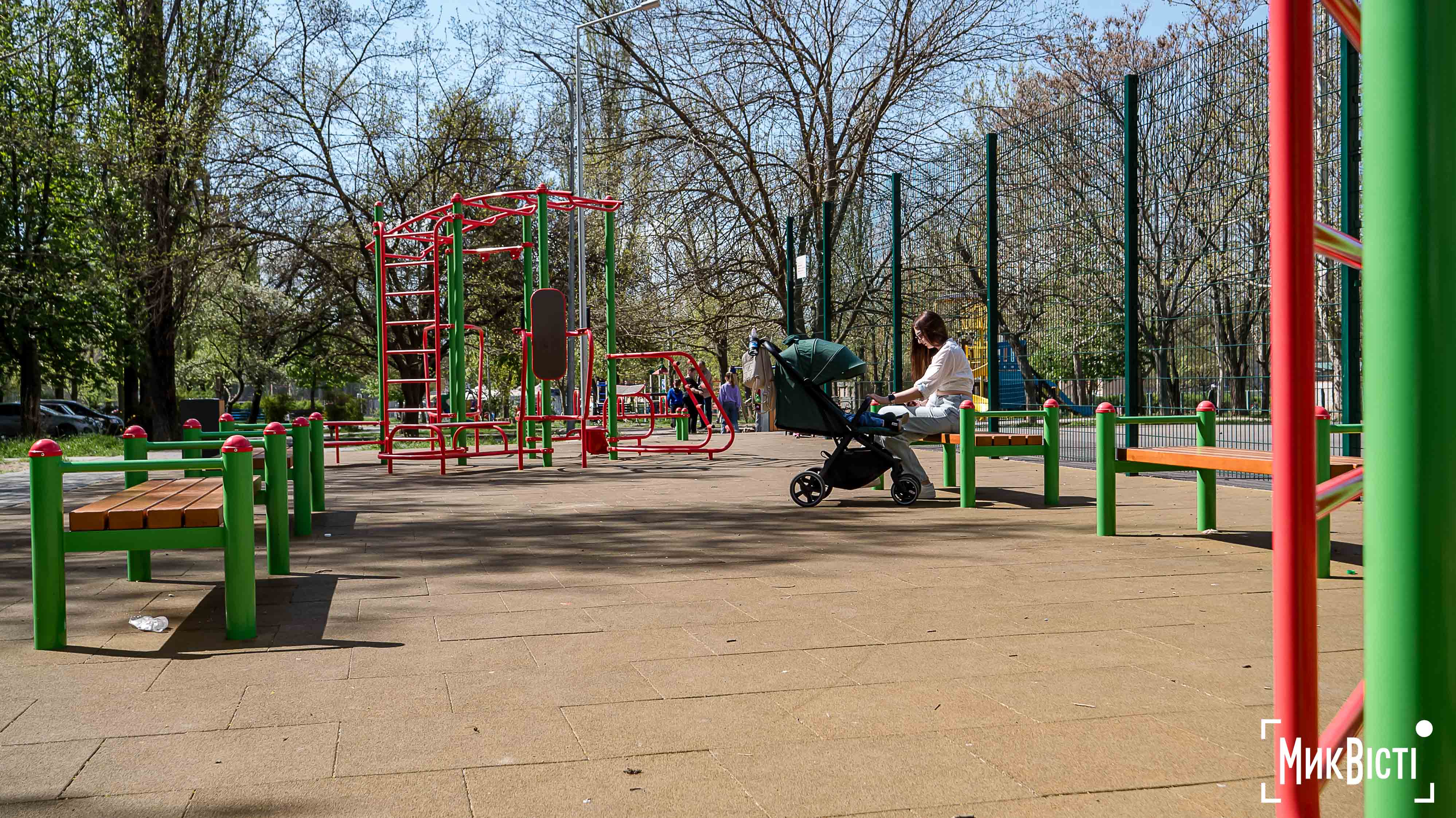 Children’s playground in the Korabelnyш district, the renovation of which was implemented by UNOPS with funding from the Danish government, April 2025, photo: NikVesti
Once the project has been approved, the partner organisation prepares the technical documentation and cost estimates. An international tender is then announced based on these. The documentation specifies in detail exactly what needs to be procured, the technical requirements for the equipment or works, and the criteria by which the winner will be selected.
«For example, we signed a contract with UNOPS stipulating that certain works must be carried out. UNOPS then prepares the project and cost estimates, on the basis of which they launch the tender via their platforms,» said Jacob Hansen.
International organisations have several main tender platforms. Therefore, unlike Ukraine’s Prozorro, international procurements are posted on various platforms. They often take place via the organisations’ own portals or specialised international electronic platforms. In this article, we will look at the three most common ones.
Tenders within the framework of Denmark’s partnership with Mykolaiv are published on the UN Global Marketplace, which is used by UN organisations, and the NEFCO Procurement Portal, which is used by NEFCO — the Nordic Environment Finance Corporation.
Among others, there is also the STEP (Systematic Tracking of Exchanges in Procurement) procurement tracking system, where World Bank-funded procurements are published.
Analysing examples of tenders
The tender exists — but no participants are visible: how UNOPS procurement works
We examined how international tender platforms operate using projects in the Mykolaiv region as examples. One of these is the installation of a water tower in the village of Bilozirka. The procurement was announced by UNOPS on 4 March 2026. The tender was published on the international procurement portal, the United Nations Global Marketplace.
It is not difficult to find such an announcement: the portal has a search function where you can filter tenders by country, organisation or keywords. That is how we found the procurement related to the Mykolaiv region.
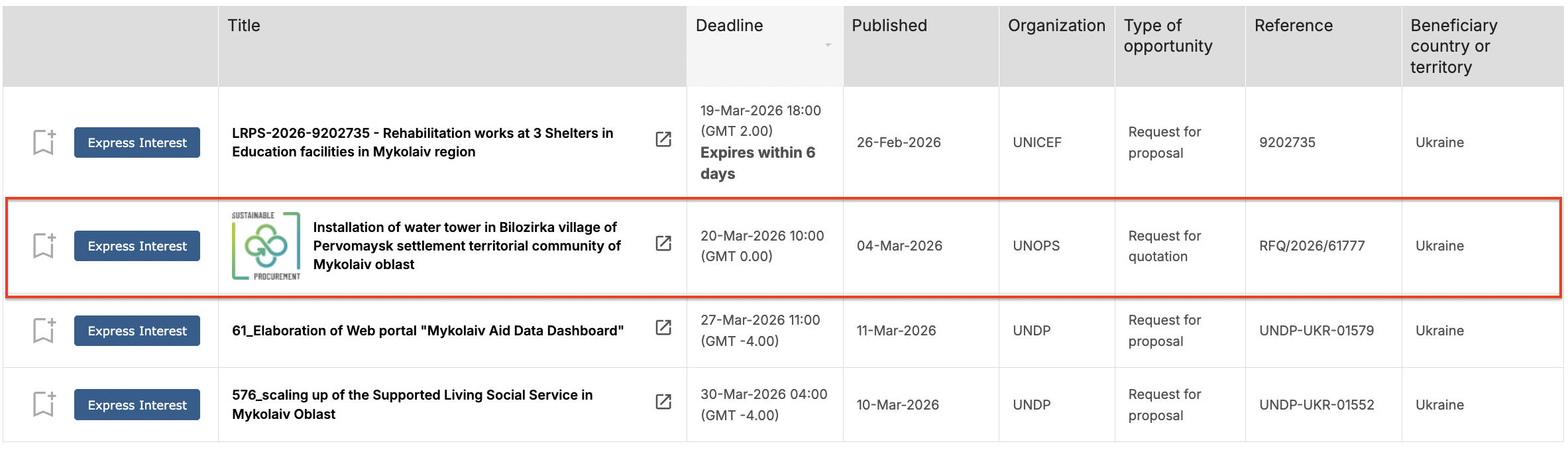 Tender for the installation of a water tower in the village of Bilozirka, screenshot from UN Global Marketplace
The tender listing contains basic information: a brief description of the project, the publication date, and the deadline for submitting bids — in this case, 20 March 2026. The following documents are also publicly available: technical specifications, a list of works, requirements for the contractor, a budget template, tender documentation, and instructions for participants.
However, it is not possible to view the list of companies participating in the tender and their proposals, as this information is not published publicly. The companies themselves must register on the portal in order to submit their documents, ask questions and upload proposals.
Once the tender is complete, only information about the winning company and the signed contract is made publicly available. The decision on the winner is made by a specially established commission, UNOPS representatives told NikVesti in a comment.
«The commission may select the lowest technically acceptable bid, or adopt a more sophisticated approach that takes into account the price-quality ratio. The evaluation methodology is always stated in the tender notice, so participants know which criteria will be applied. The winner is determined based on the evaluation of the bids. The winning bidder receives a cooperation proposal from UNOPS. A contract is signed, and work begins,» they explained.
UNOPS representatives assured NikVesti that their procurement processes, in line with international standards, are transparent.
«Anyone has access to a constantly updated list of contracts, which specifies the winner, the total contract value and the subject of the procurement. No registration on the platform is required to access this data,» they noted.
You can view the list of companies that have already been awarded contracts for specific projects on the UN Global Marketplace platform under the ‘Contract awards’ section . In the search criteria, we specified the organisation — UNOPS, the territory — Ukraine, and the year — 2026. Thus, since the start of the year, the UN Office for Project Services has concluded agreements with six companies:
- BOHART BUD LLC for the installation of fire alarm systems in three hospitals;
- KRAINA-PARK LLC for the installation of water towers in Novomykolaivka and Pervomaiske;
- MEDION GROUP LLC for the supply of medical furniture;
- INMED UKRAINE LLC for the supply of ophthalmic equipment;
- MEDSERVICE PLUS LTD LLC for the supply of ophthalmic equipment;
- ALT UKRAINE LTD LLC for the supply of medical equipment.
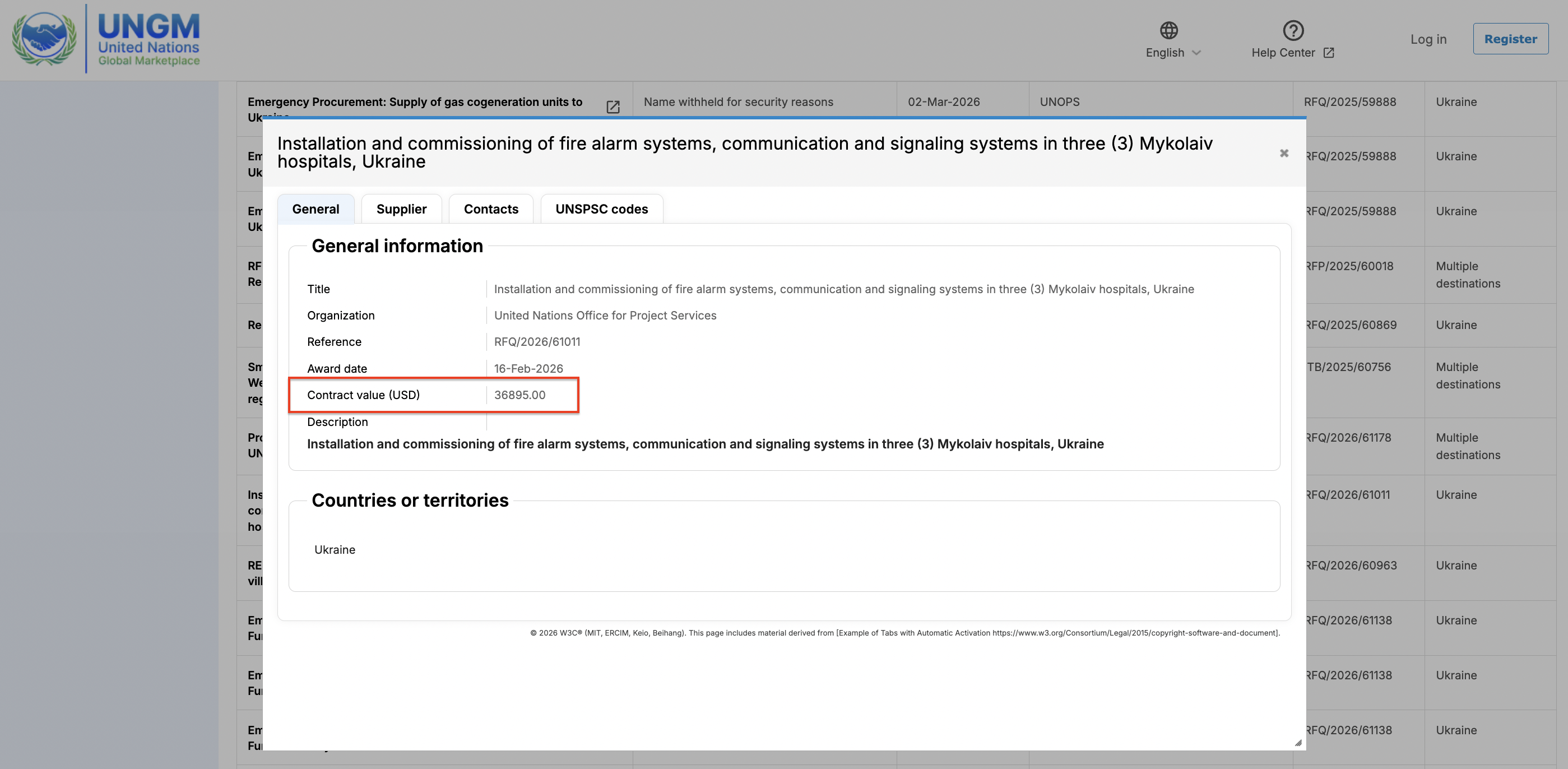 Bogart Group was awarded a contract worth $36,800 to install fire alarm systems in three hospitals. Screenshot from the UN Global Marketplace platform
«We have been supporting the Mykolaiv region since 2022, and during this time we have conducted over 70 tender procedures for the city and the region. The total value of goods and services we have procured through these tenders is just over $35 million,» UNOPS noted.
Documents are sent on request: how NEFCO tenders work
We found another example of an international tender related to the reconstruction of infrastructure in the Mykolaiv region on the NEFCO Procurement Portal.
On 25 February, a tender announcement appeared there for the construction of a 9.9 MW solar power plant. It is intended to supply electricity to public facilities in Mykolaiv. Funding for this project is provided by the Danish government.
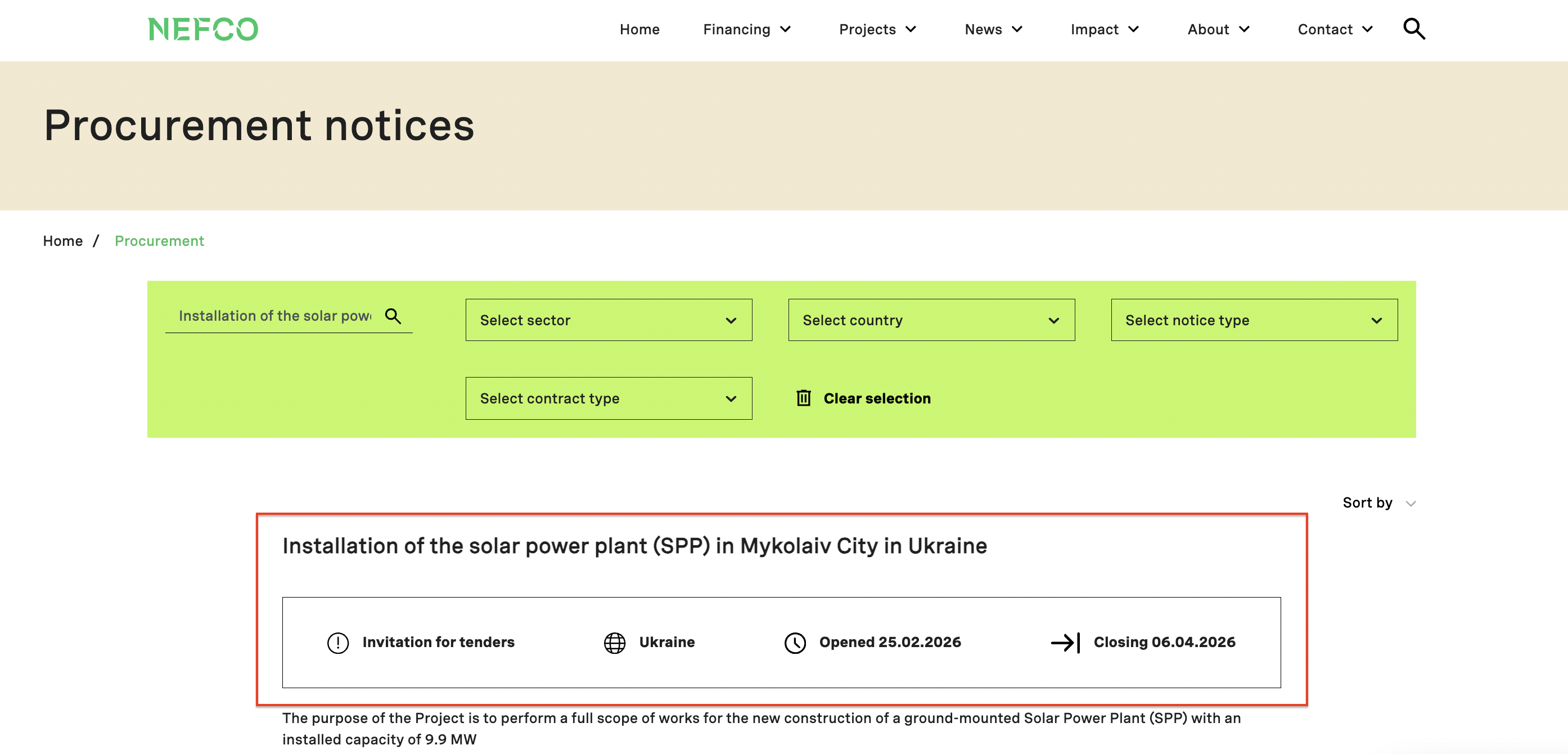 Tender for the construction of a solar power plant, screenshot from the NEFCO Procurement Portal
The procurement process will run until 6 April. The notice also specifies the indicative implementation timeline: work is scheduled to begin in May 2026 and be completed no later than May 2027.
It is not difficult to find this announcement on the NEFCO portal. The Procurement notices section features a search function by country, sector or keywords. In addition, the page displays a list of the latest procurement notices.
A brief description of the project, the invitation to tender, the basic requirements for the contractor and the deadline for submitting bids are publicly available.
However, unlike the Ukrainian Prozorro system, the full tender documentation package is not published on the portal. The notice itself states that potential participants can only obtain it upon written request. To do so, the company must send an email to the tender agent. Only then will the full set of documents be sent to them.
Participants also submit their tender proposals outside the portal itself — sending them electronically by email. Therefore, it is not possible to view the list of companies participating in the tender and their proposals in the public domain.
We asked NEFCO why this particular model is used for procurement — where documentation is sent by email and bids are submitted outside the portal. NEFCO explained to NikVesti that «NEFCO’s policy ensures confidentiality to prevent any influence on the tender committee and prohibited practices».
«All submitted bids are evaluated by a tender committee appointed by the community, with the support of an independent consultant. Once the procedure is complete, information about the winner is published, and all stages of the procurement process can be reviewed and appealed in accordance with the complaints procedure. This format ensures transparency, integrity and the protection of fair competition,» they noted.
 A house in Mykolaiv restored with Danish funding, April 2025, photo: NikVesti
Closed procurement system: how the World Bank’s STEP works
Using the international procurement system STEP, we attempted to find tenders within the framework of the «HOPE: Housing Repair for Empowerment» project, funded by the World Bank. As part of this project, plans are in place to develop reconstruction projects for 69 high-rise buildings in Mykolaiv, costing at least 150 million hryvnias.
However, searching for tenders in STEP proved not to be so straightforward. In fact, this system functions primarily as an internal procurement management tool. Only registered project participants — clients, contractors and World Bank specialists — have full access to it. Through STEP, they submit tender documents, agree on procurement procedures and administer contracts. Therefore, for ordinary users — journalists or community members — the system effectively remains closed.
The World Bank’s rules explain this model by stating that the procurement system is primarily designed for use by tender participants and for project administration. Some of the documents and company proposals contain commercially sensitive information, so they are accessible only to registered participants in the procedure.
We then tried to find procurements for the HOPE project in the public section of the World Bank’s website — in the «Procurement Notices» section. This section allows searches by country, keywords, method and type of procurement. However, we were only able to find general information about the project itself, as well as calls for expressions of interest for individual procurements within the HOPE project. This is the stage at which companies confirm their willingness to participate, without submitting detailed documents or price proposals.
As a result, the public has to look for information on procurement in World Bank projects at the local level. For example, information on the stages of procurement within the HOPE project is published on the website of the City Council’s Department of Housing and Communal Services. The most recent such announcement was published on 3 February 2026. This document contains the results of the expression of interest evaluation stage, which was passed by only two companies: one Turkish and one Ukrainian.
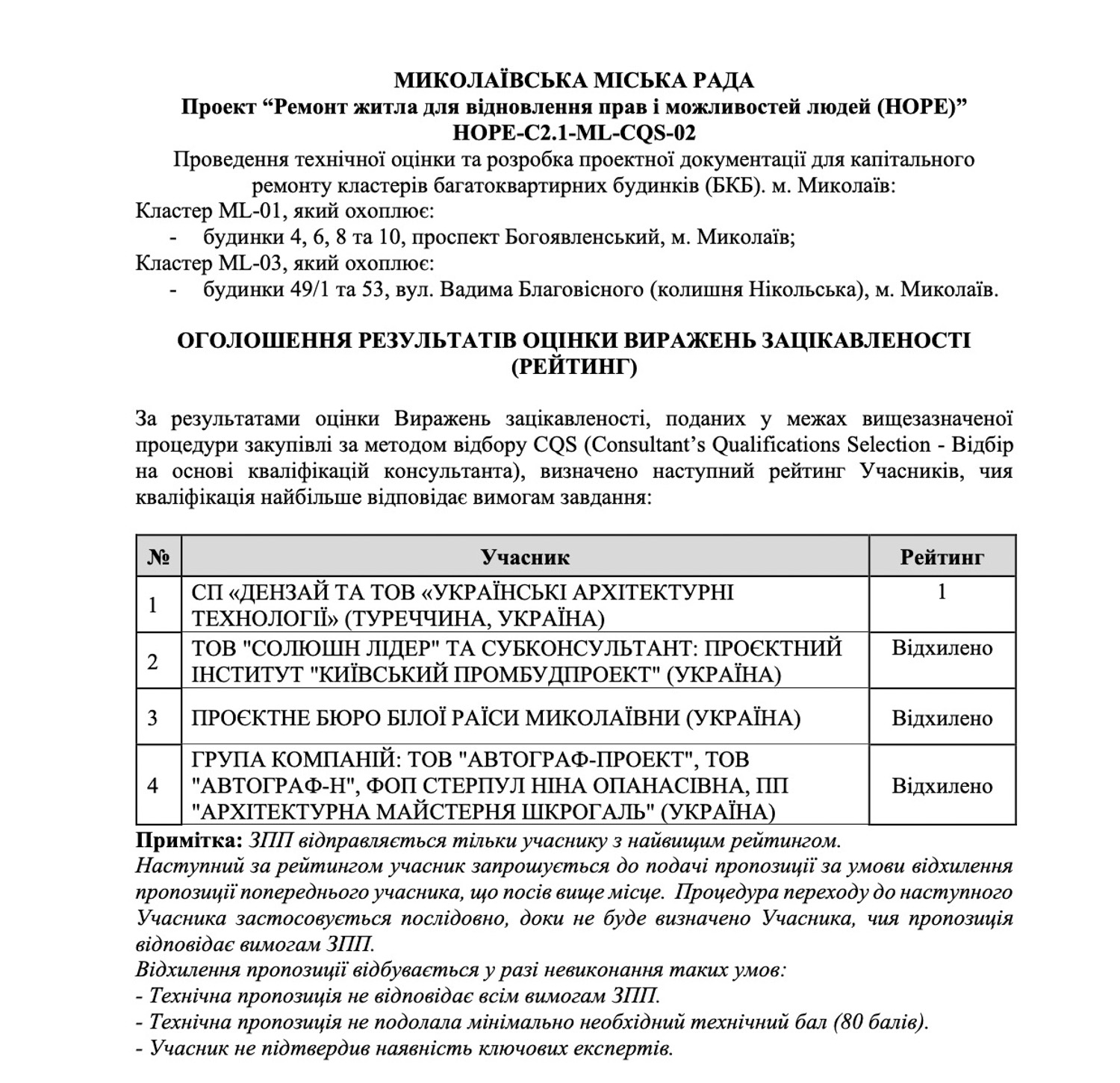 Announcement of the results of the expression of interest evaluation. Document published by the Mykolaiv Housing and Utilities Department
«First, a procurement notice is published, after which interested parties send a letter of interest. After that, the procurement is announced directly with all the requirements, and based on these requirements, participants prepare a package of documents. They deliver this package of documents in person and also submit a copy online,» explained Serhii Korenev, Deputy Mayor of Mykolaiv, in a comment to NikVesti.
In other words, in this case, it is easier for an ordinary resident of the community to find out about contractors from the city council’s website than from the World Bank’s global procurement system. But even in this case, the list of participating companies and their bids remain confidential.
Can international tenders be more transparent?
The main difference between international procurement and the Ukrainian Prozorro system is the level of information transparency.
On Prozorro, you can see practically the entire process: who applied for the tender, what proposals the participants submitted, how they were evaluated, and who won. In most international systems, this information remains confidential.
On platforms used by international organisations, the public can usually only see the tender announcement or the contract that has already been signed.
The list of companies that submitted bids, their documents or evaluation details are not published in the public domain. Under international procurement rules, such information is considered commercially sensitive. And even local authorities will only receive the procurement results after the winner has been announced.
«In reality, they only provide us with this information once they have already selected a contractor,» explained Mykolaiv’s Deputy Mayor Serhii Korenev.
 Mayor Oleksandr Senkevych with his deputy Serhiy Korenev at the Ukraine Recovery Conference (URC) in Berlin, photo: NikVesti
According to him, if a project is funded by donors — for example, the Danish government or international financial institutions — the procurement procedures are determined by the donor organisation itself.
«You see, the thing is that, given that this is donor money, they set the requirements. When it comes to organisations such as NEFCO or the World Bank, there is specialised legislation that effectively gives precedence to the procedures of international organisations over those of national legislation.
In other words, we effectively have no influence over this, and the state says that if it is extra-budgetary money, then the donor organisation itself effectively determines the procedure. But I generally believe that our Ukrainian Prozorro platform is, in some cases, better than its foreign counterparts,» said Serhii Korenev.
International organisations say that the transparency of tenders largely depends on how actively they are communicated at the local level.
«Improving the transparency of international tenders requires a comprehensive approach. NEFCO has already implemented a number of mechanisms to enhance transparency and accountability, but effectiveness could be even greater provided there is active communication at the local level. A key tool could be the appointment of a communications specialist within the community who would be responsible for regular public reports.
Another important area is publishing updates on the progress of work. Regular reporting through the dissemination of news, photos, videos and other informational materials allows the community to follow the progress of the project in a simple and visual format without having to delve into complex technical procedures,» NEFCO representatives stated in a comment to NikVesti.
At the same time, according to representatives of international institutions, more active communication with communities would help to increase transparency. For example, regular reports on the progress of projects, the publication of photos and videos of completed work, or separate information sessions for local companies and the public.
«This year, we plan to continue our outreach activities: we intend to hold information sessions focusing on specific sectors — such as construction — as well as more general events with no restrictions on the profile of participants,» UNOPS representatives told us in a comment.
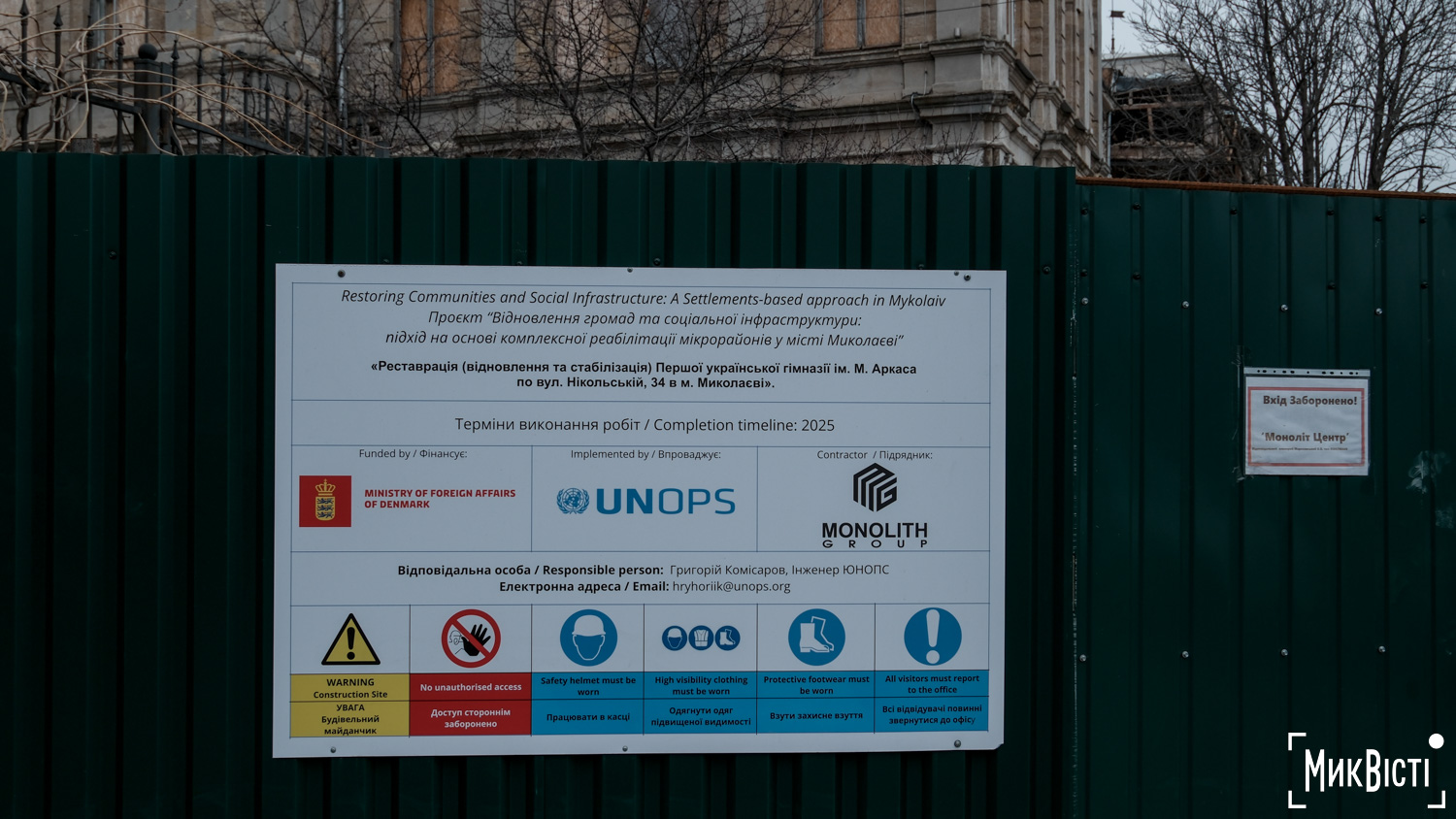 Construction hoarding around the Mykola Arkas Gymnasium, the reconstruction of which is being implemented by UNOPS with funding from the Danish government, March 2025, photo by NikVesti
International tenders, through which some of the Mykolaiv region’s reconstruction projects are implemented, operate differently from public procurement in Ukraine. On the platforms of international organisations, one can find the tender notice, its terms and conditions, and, once completed, information about the winning company and the contract awarded.
However, what happens between these stages usually remains private. The platforms do not display a list of companies that have entered the competition, nor do they publish their tender bids. This is common practice in international procurement — such data is considered commercially sensitive information.
But since these cases involve funds from international donors rather than the state budget, it is the donor organisations themselves that determine the rules for such procurement.
Yuliia Boichenko, NikVesti
This material was prepared as part of the «Pulse of Recovery: 1-0» project, implemented by the NGO Window of Recovery with the support of International Media Support. The material represents the authors’ views and does not necessarily reflect the position of the NGO ‘Window of Recovery’ or International Media Support.
