
Why Mykolaiv residents do not use shelters: NikVesti survey
-

- Alona KokhanchukReporter
-
 3000 +
Wow! Over 3,000 visitors have viewed this content!
3000 +
Wow! Over 3,000 visitors have viewed this content!
-
 Prefer on Google
-
3K
Wow! Over 3,000 visitors have viewed this content!
-
Prefer on Google
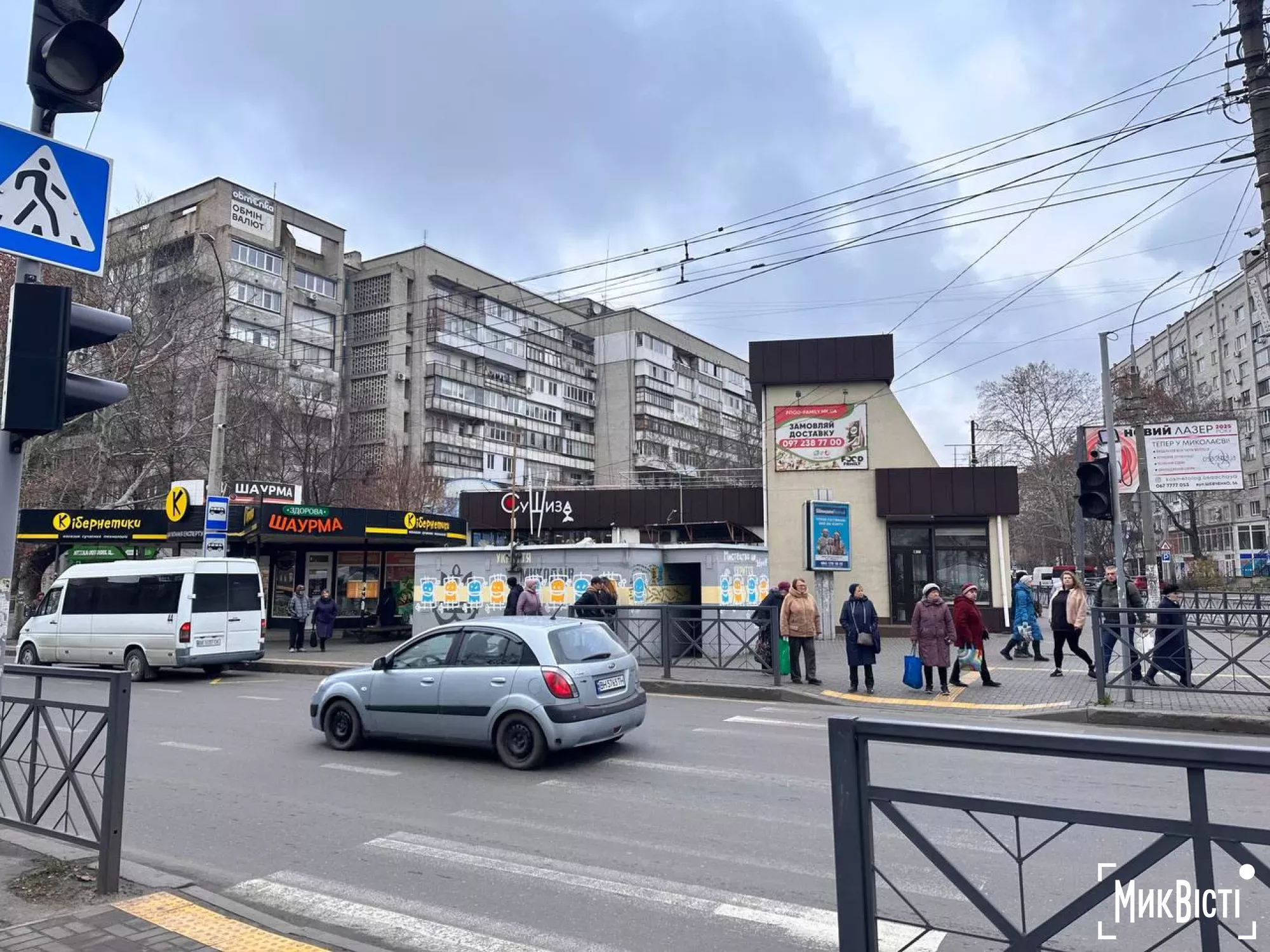 A mobile shelter on 3 Slobidska Street in Mykolaiv. Photo: NikVesti
There are currently 461 shelters in Mykolaiv, but a survey of NikVesti readers showed that part of the city's population does not use them.
This is described in the article: «White spots on the security map: how the situation with shelters in Mykolaiv has changed in almost four years of war».
As of November, the city's population was about 430,000, which is almost identical to the number before 24 February 2022. For this number of people, there are 461 shelters in the city.
This number of protective structures is not enough for the city. According to official data from Mykolaiv City Council, the city's total need is 2, 174 protective and dual-purpose structures.
To understand the overall picture, NikVesti conducted a survey of readers and asked them to answer the question whether people use shelters and, if not, why not. The journalists also interviewed passers-by on the streets.
The results of the survey showed that the vast majority of city residents do not use shelters. Of the 1,252 respondents, 84% said they did not go to shelters at all during air raid alerts. Another 12% said they use them occasionally, and only 4% said they go to shelters all the time.
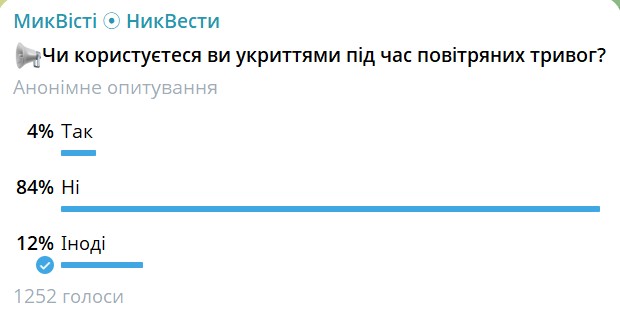 The results of the survey conducted in the Telegram channel NikVesti.
The reasons for this choice are different. Some citizens deliberately decided not to go to the shelters because they were tired of constant air raid alerts, psychologically exhausted, or convinced that the risks are the same at home. At the same time, readers' comments show that the main problem is not indifference, but the lack of a real opportunity to use the shelter.
People from different districts of the city — Inhulskyi, Korabelnyi, Zavodskyi, Tsentralnyi, Varvarivka, Lisky, Namyv — repeat the same thing: there are no shelters nearby, or they are closed, or in a state of disrepair that does not inspire confidence.
For many residents, shelters exist only in reports and on maps on the official website of the city council. In real life, people often don't know where to go during an emergency.
«Do we have shelters? Really?» one of the readers wonders.
«There are no shelters in Raketne Urochyshche, the nearest one is a few kilometres away», others write.
Even where shelters are formally marked on the map, accessibility is often a problem. People say that the entrances are locked, there are no keys, the guards do not let them in, and even more so at night.
«The shelter at the school is a 5-7 minute walk away, but no one knows if they will let you in at night», writes Iryna.
«The school principal said the shelter is only for students. No outsiders are allowed in, day or night», says a resident of the area of school 39.
A separate topic is basements, which are officially considered the simplest shelters. In their comments, Mykolaiv residents do not consider them safe.
«A basement is not a shelter. A basement is a grave», writes one of the readers.
«Communications overhead, no ventilation, dampness and darkness — I will not take my children there», adds another resident.
Basements are often either cluttered, flooded, or sold for shops and cafes before the full-scale war.
«"The nearest bomb shelter in our neighbourhood was sold for a shop»," Kateryna writes.
«»"We have a basement in our house, but there are shops there and they don't allow us to go down," says Alyona, a reader of «NikVesti».
Even the modular concrete shelters at bus stops do not inspire confidence. People say they are dirty, neglected and often used for other purposes.
«It's impossible to pass by that shelter at the bus stop without fainting — people have turned it into a toilet», writes a resident of 6 Slobidska Street.
«What's the point of going there? I can sit behind the walls at home from the debris», adds another reader.
Another reason given by Mykolaiv residents is distance and time. It often takes 10-20 minutes to walk or run to the nearest shelter, in the dark, without light, with children or elderly relatives.
«By the time you get there in the dark at night, it's already lights out,» writes a resident of Korabelnyi district.
On the streets of the city, citizens on camera to NikVesti journalists also admit that they rarely use shelters. People say that the problem is not only the reluctance to go to the shelters, but also the lack of an accessible and understandable system of shelters in the city. At present, most citizens continue to face the alarm where they are — in their own apartments.
Earlier it was reported that Mykolaiv lacks more than two thousand shelters, and this problem is most noticeable in the Lisky, Namyv and Pivdennyi neighbourhoods. It is there that the city authorities plan to install mobile shelters, as there are virtually no stationary shelters in these areas.
At the same time, Mykolaiv is counting on government support for the development of the shelter network. Calculations of the city's needs have already been submitted to the regional military administration to be included in the operational plan for the implementation of the Strategy for the Development of the Civil Protection Facilities Fund until 2034.
In July of this year, Roman Vozniak said that Mykolaiv lacks two thousand shelters to protect the entire population of the city.
He said this after a situation when Mykolaiv residents were unable to get into departmental shelters after hours during shelling. The editors of NikVesti were contacted by city residents who were unable to get into the shelter at 173 Tsentralnyi Avenue during the alarm. All other shelters nearby also belong to institutions or enterprises that are on the balance sheet of municipal or private institutions and accept people only during working hours. Mykolaiv City Hall promises to discuss the issue of shelter availability at a meeting of the executive committee.
It should be noted that Mykolaiv region is among the five regions that showed the best performance in 2024 in terms of building and making shelters ready.
We also recall that in Mykolaiv, shelters in kindergartens and a vocational school were inspected and a problem was identified: people with disabilities and people with limited mobility cannot get to the shelters on their own.
