
The Mykolaiv Alumina Plant has lost its criticality and cannot continuously process 48 million tonnes of hazardous sludge
-

- Kateryna SeredaEditor-in-chief
-
 50000 +
The king of views! More than 50,000 visitors have seen this content!
50000 +
The king of views! More than 50,000 visitors have seen this content!
-
 Prefer on Google
-
50K
The king of views! More than 50,000 visitors have seen this content!
-
Prefer on Google
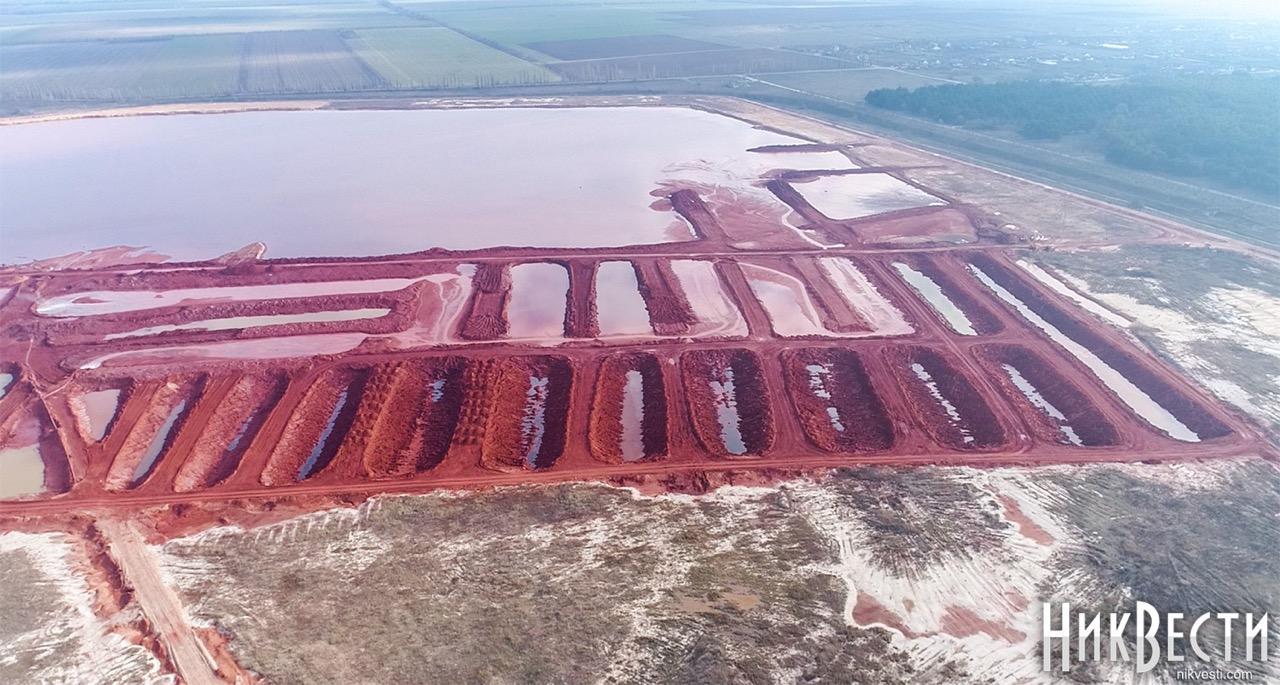 The Mykolaiv Alumina Plant was confiscated from Russian oligarch Oleg Deripaska, archive photo NikVesti
The Mykolaiv Alumina Plant, which the state confiscated from Russian oligarch Oleh Derypaska, cannot ensure the continuous processing of two sludge storage facilities near Mykolaiv due to the loss of its status as a critical infrastructure facility.
This was written on Facebook by Alla Riazhskykh, chair of the Mykolaiv Regional Council's ecology commission, who visited the enterprise.
As is known, in March 2024, Ukraine completed the process of nationalising the Mykolaiv Alumina Plant (MGZ), which was part of the RUSAL group of companies, and since then it has been under the management of the State Property Fund of Ukraine (SPFU). On 20 March 2024, the SPFU expressed on its website an unambiguous position on plans to sell confiscated Russian property, the proceeds of which would be «directed to support and restore Ukraine». However, since then, there has been no movement on the sale of the plant.
With the start of full-scale war in February 2022, the company ceased production of alumina, and its corporate rights have been under arrest since June 2022.
Of the five thousand workers, about 400 remain today, who are involved in servicing sludge storage facilities covering an area of about 400 hectares and preserving the company's property, MGZ head Oleksii Medvid said earlier in a comment to NikVesti.
According to Alla Riazhskykh, from 1 January 2026, MGZ will no longer be considered a critical infrastructure facility. This means that the enterprise will be subject to prolonged power outages, which will make it impossible for the pumping station to operate.
«For a month and a half, a strategic enterprise in the region, which is a potentially catastrophic hazard from an environmental point of view, will not be able to operate its pumping stations continuously,» wrote Alla Riazhskykh.
In addition, it should be noted that the enterprise's lack of critical status prevents it from reserving employees involved in the maintenance of sludge storage facilities.
Earlier, it was reported that in two years of management, the State Property Fund did not help the Mykolaiv Alumina Plant (MGZ), confiscated from Russian oligarch Oleh Derypaska, to solve a critical environmental problem related to the emergency condition of the sludge field irrigation systems, which became known back in the summer of 2022.
«To summarise the environmental threat — two sludge fields, 48 million tonnes of red sludge. This is a treasure trove of Mendeleev's periodic table and a huge potential problem for the ecology of our region... We don't have much time before the enterprise simply runs out of funds to maintain the sludge fields, among other things. I am sure that the capital does not fully understand the scale and complexity of this issue,» the councillor wrote.
She also published a video showing what the sludge fields of the Mykolaiv Alumina Plant look like now.
NikVesti has repeatedly written about the possible environmental disaster that could occur due to the risks of sludge dusting and the leakage of sludge water into the Bug Estuary.
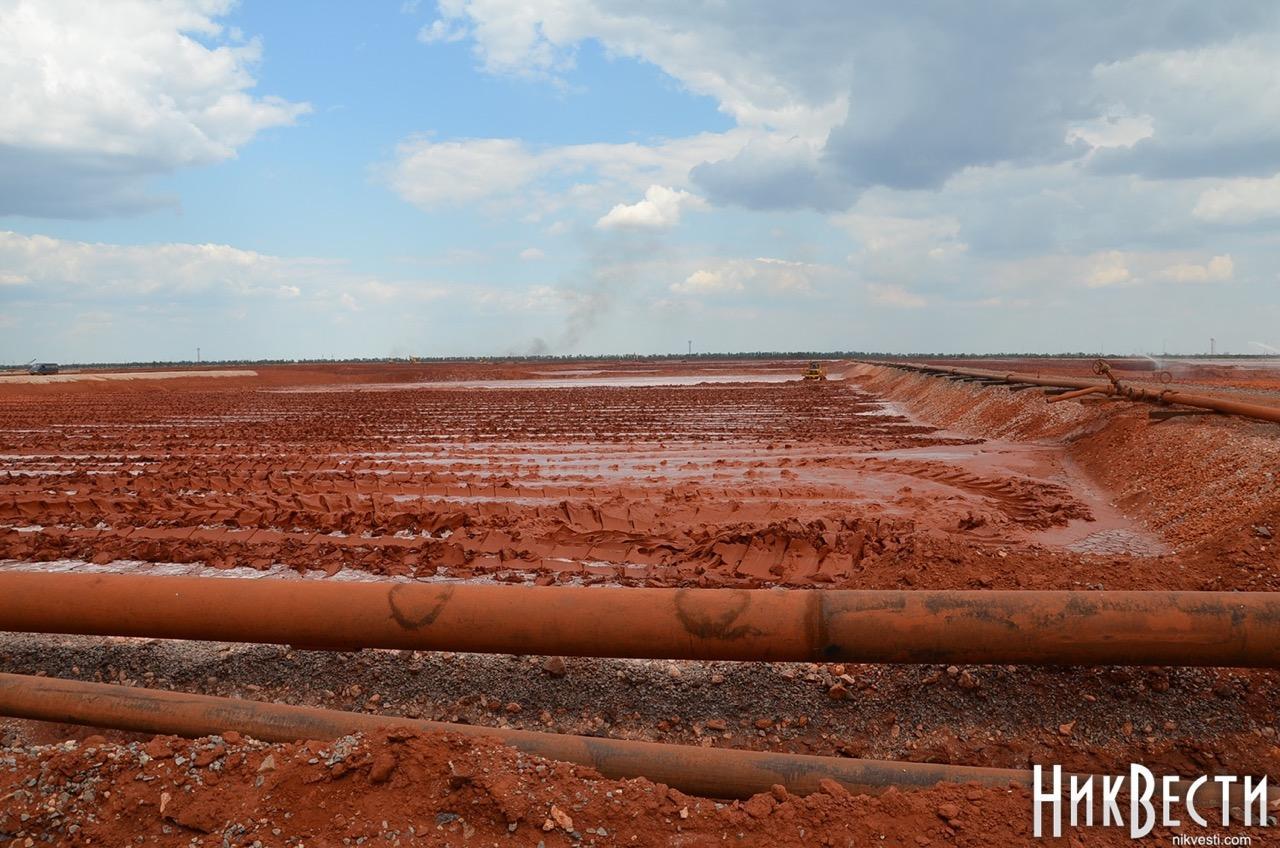 The sludge fields must be constantly moistened and the sludge water pumped out to avoid an environmental disaster, archive photo NikVesti
Mykolaiv Alumina Plant — a slow-acting environmental «bomb»
The plant, which has been out of operation for five years, has become many times more dangerous to the environment than when it was operating at full capacity. This position was expressed by the head of the State Environmental Inspection, Ihor Zubovych, in response to an information request from NikVesti regarding the situation at the MGZ since the start of the full-scale war.
According to information received by NikVesti received from the State Environmental Inspection, on 19 July 2022, the Mykolaiv Alumina Plant reported that due to shelling in the area of sludge storage facility No. 2, it was difficult to process the surface of the red sludge deposited in the sludge storage facility basins, which created the risk of red sludge dusting.
As a result, the enterprise is treating only one-third of the area of sludge storage facility №2: «combat operations in the area of sludge storage facility №2 and damage to the dust suppression system lines, making their restoration difficult; inability to maintain the dust suppression system due to the blocking of the enterprise's accounts. At the same time, sludge storage facility №1 is being fully maintained by the company's own efforts to wet the area».
Twice in August 2022, once in September 2022 and once in January 2023, MGZ reported that due to increased wind speeds, uncontrolled dusting was observed from one of the sludge storage facilities, which could cause contamination of land plots outside their sanitary protection zone. The company then activated the dust suppression system at sludge storage facility No. 2.
However, due to a lack of personnel, the company was unable to carry out dust suppression work on the beaches of sludge storage facility №1.
Uncontrolled dusting of sludge from the company's sludge fields continued throughout 2023: in May, July, August (twice) and September (four times).
Until July 2022, maintenance work on the dust suppression systems of sludge storage facility №2, including restoration of the system after shelling, was carried out by a contractor, which stopped providing services because MGZ had not paid them for their work for almost six months.
In the spring of 2023, the operation of the company's sludge storage facilities became critical:
- the filling of the working bowl of sludge storage facility №1 with sub-sludge water exceeded the permissible level, threatening to pollute the waters of the Bug Estuary, located 300 metres from the sludge field.
- The level of sub-sludge accumulation in sludge storage facility №2, which has a higher alkalinity than sludge storage facility №1, has reached a critical level. Overflowing this storage facility will lead to contamination of the adjacent agricultural land.
- There is still a problem of significant dusting of sludge in field №2, which can cause air pollution. This is due to the fact that a «dry» accumulation method is used there, which requires constant monitoring and moistening of the surface.
- The sprinkler dust suppression system (necessary for moistening the sludge) that was in operation at the enterprise was damaged and failed during the hostilities.
In July 2025, the State Environmental Inspectorate of the South-Western District informed the Minister of Economy and Environment that the situation with waste at the Mykolaiv Alumina Plant was deteriorating. Environmentalists warned of the threat of a sludge storage facility breach and pollution of the Bug Estuary.
The State Property Fund plans to put the Mykolaiv Alumina Plant, confiscated from Russian oligarch Oleh Derypaska, up for sale by July 2026. The head of the State Property Fund, Dmytro Natalukha, noted that the MGZ needs to find an external investor who can «afford not to pay too much attention to military risks» and «guarantee the security of the asset with their flag and citizenship». The head of the State Property Fund named the United States and India as potential investors.


