How many servicemen from the Mykolaiv region are being held captive: the response from the Coordination Headquarters
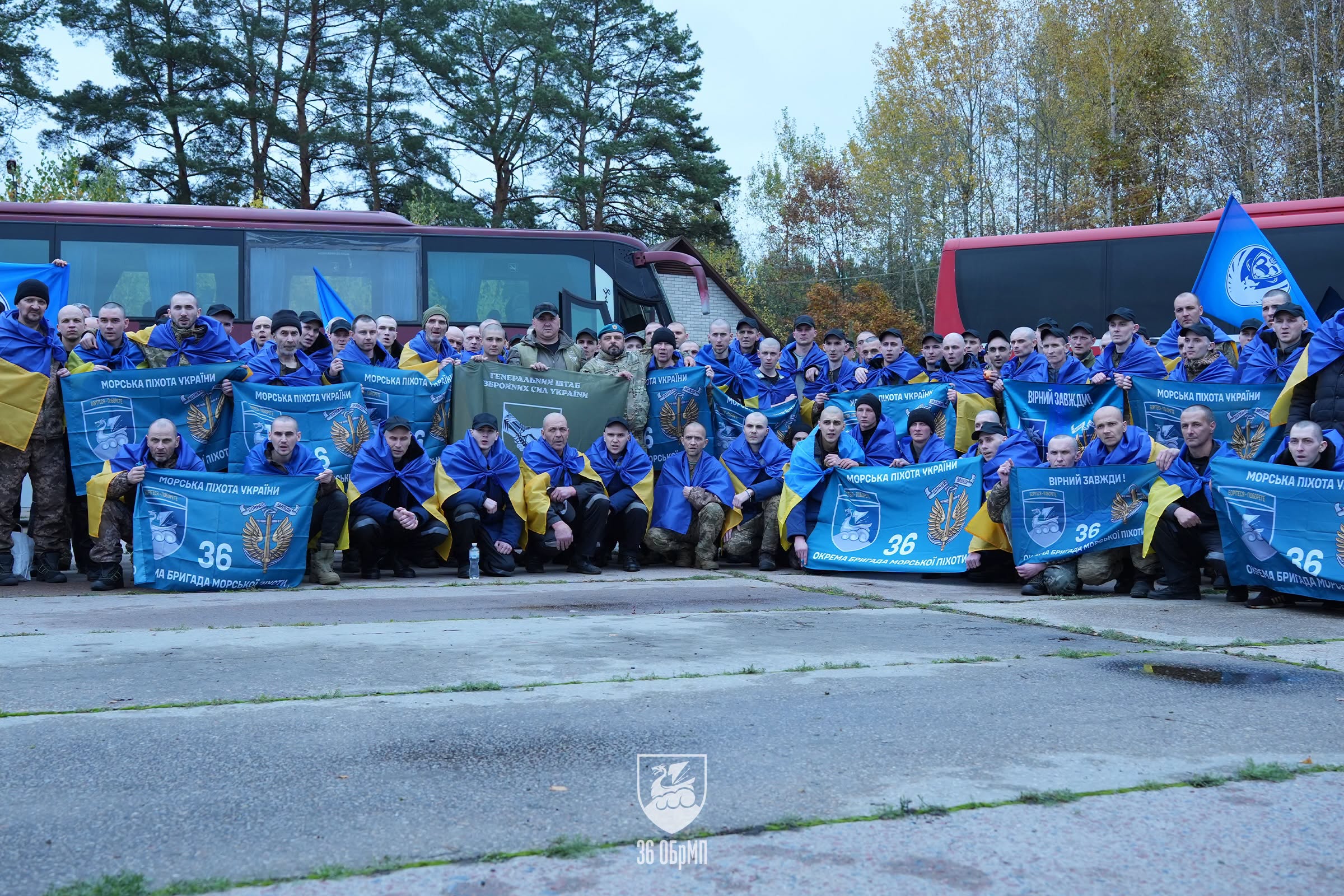 Mykolaiv marines returned during the prisoner exchange in October 2026. Photo: 36th Brigade
The Coordination Headquarters for the Treatment of Prisoners of War has information on the number of servicemen from the Mykolaiv region currently held captive by Russia, but does not disclose this data publicly.
This was reported by NikVesti in an interview with the secretary of the Coordination Headquarters for the Treatment of Prisoners of War, Brigadier General Dmytro Usov.
As Dmytro Usov noted, the Coordination Headquarters’ information system allows a list of prisoners of war to be compiled within a few minutes based on various criteria. This includes not only those born in the Mykolaiv region, but also servicemen who served or are registered in the region.
«I cannot give that figure at the moment. But thanks to the Coordination Headquarters’ information system, this search based on key criteria can be carried out quickly. In other words, in literally a few minutes, I will have a list of everyone who is either a native of the Mykolaiv region, has served in the Mykolaiv region, or is registered in the Mykolaiv region. A selection is made, and it is done quickly thanks to the information system. The figures may be known, and we can quote them,» said Dmytro Usov.
In response to a follow-up question from a NikVesti correspondent regarding the possibility of publishing this data, the secretary of the Coordination Headquarters replied that it is used for internal purposes. In particular, the headquarters analyses the trends in the number of servicemen taken prisoner and the number of those missing in action on a weekly basis, broken down by region.
«We do not disclose the figures publicly because we take these figures into account directly in our work. And we pay attention to this. In the same way, we carry out a weekly analysis of how many have been taken prisoner from a particular region, for example, the Mykolaiv region. How many from the Mykolaiv region are missing in action. Why do we carry out this analysis? To draw the attention of our counsellors and social services to a particular region if we observe certain trends in the number of people taken prisoner or the number of those missing,» he explained.
It should be noted that, as of 2024, the human rights organisation «Media Initiative for Human Rights» reported that nearly 1,300 servicemen from the Mykolaiv-based 36th Separate Marine Brigade named after Rear Admiral Mykhailo Bilynskyi are being held captive by the Russian Federation.
A large-scale prisoner exchange between Ukraine and Russia is currently being prepared. As of November 2026, Russia had agreed on a list of some of the Ukrainian prisoners of war who are due to be returned during the forthcoming exchange. Discussions regarding the remaining names are still ongoing.
It should be recalled that in November 2026, Volodymyr Zelenskyy announced the possibility of a large-scale prisoner-of-war exchange on a «1,000 for 1,000» or «1,500 for 1,500» basis. Such an agreement was reached during negotiations between Ukraine, the US and Russia in Abu Dhabi.
Previous large-scale prisoner exchange
Ukraine and Russia had previously reached a similar agreement during talks in Istanbul on 16 May 2025. At that time, the parties agreed on a large-scale prisoner exchange on a «1,000 for 1,000» basis, which took place in three stages between 23 and 25 May.
On the first day, 390 Ukrainians returned home, including 270 military personnel and 120 civilians. On 24 May, a further 307 defenders were released, and on 25 May, the remaining 303 military personnel. In total, Ukraine repatriated a thousand people.
Among those released were 24 marines from the 36th Separate Marine Brigade named after Rear Admiral Mykhailo Bilynskyi, who returned to the Mykolaiv region. Following their release, they were to undergo treatment and rehabilitation.

You read this text for free. To keep it that way, the newsroom's work is supported by members of the NikVesti Club.
Cancel any time