Mykolaivvodokanal owes ₴36 million for water supplied via the new water main: Sienkevych is asking the state for this money
- Yuliia Boichenko
-
•
-
12:53, 18 November, 2026
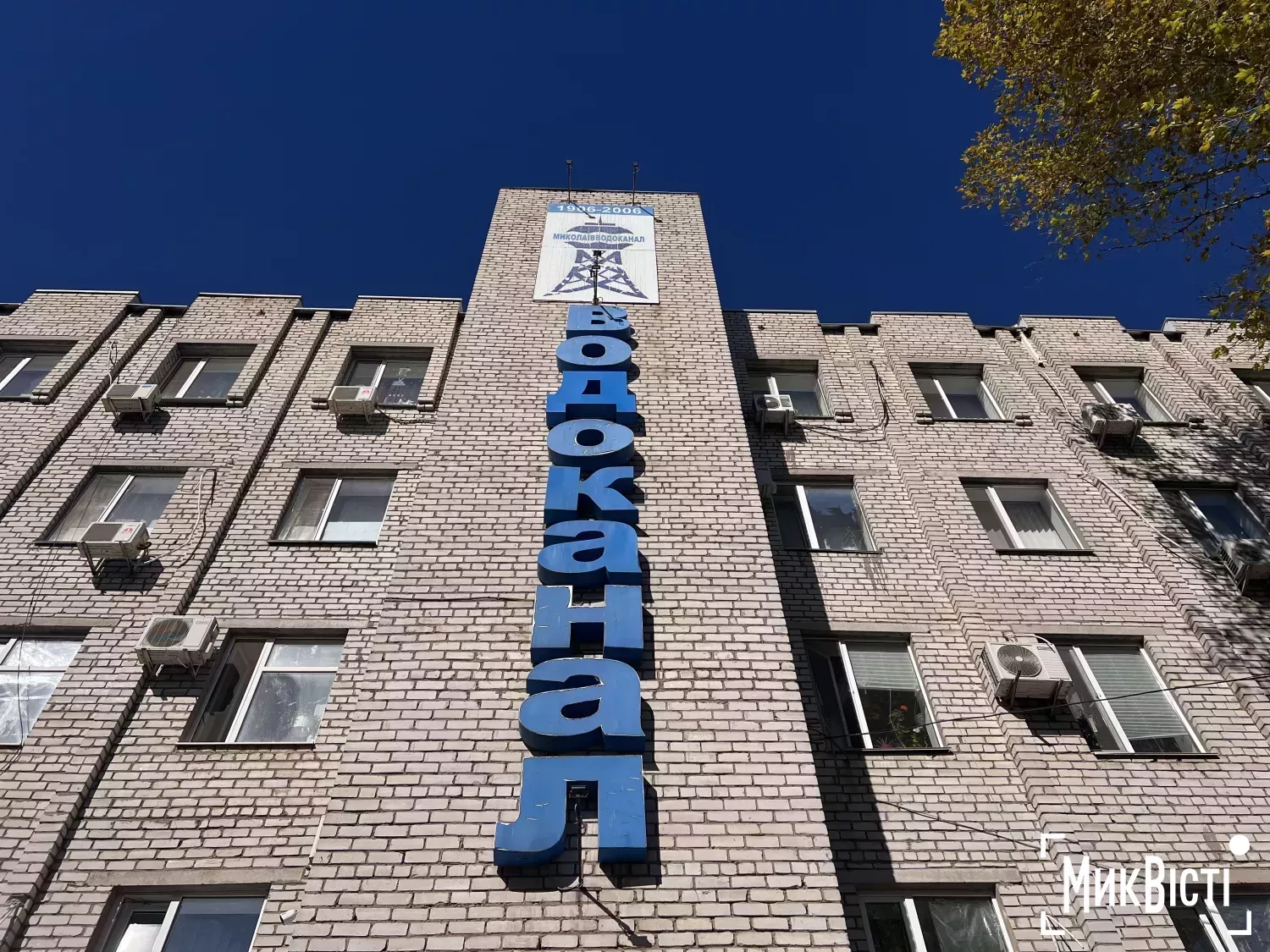 The «Mykolaivvodokanal» building, photo by NikVesti
The municipal enterprise «Mykolaivvodokanal» has not been paying the full amount for water supply and treatment for several months. The debt has now reached 36.1 million hryvnias.
This information was confirmed by the mayor, Oleksandr Sienkevych, in a comment to NikVesti, as reported in the article «Who will be responsible for the new water treatment plants in Mykolaiv and will this affect the tariff?».
«This is true. Or rather, it is partly true, because the company makes monthly payments, and the latest figure represents the outstanding balance for October.» Moreover, it is primarily due to the fact that the State Treasury did not process the payments,» said the mayor.
The mayor explained that the city allocates funds to «Mykolaivvodokanal» from its budget, thereby replenishing the company’s authorised capital. It is from these funds that the water utility pays the Regional Water Resources Office, which currently maintains the new water pipeline and the preliminary water treatment plant.
However, the city now lacks the funds for further payments.
According to him, this is precisely why Mykolaiv is asking the state for 819 million hryvnias to cover the shortfall in the city budget until the end of the year. A significant portion of this sum is needed, in particular, to settle the water utility’s accounts.
«So, if we were unable to replenish this authorised capital, then they, of course, were unable to transfer these funds. But in reality, there is a problem. This problem is well known and will soon be made public, because we are short of money. We no longer have the funds to replenish the authorised capital. The money we are asking the state for to see us through this year includes, amongst other things, these funds to replenish the water utility’s authorised capital. In total, we are asking for 819 million hryvnias,» said the mayor.
If the city does not receive funding, the utility may run out of money to pay the state operator for water. Oleksandr Sienkevych warns that this could cause problems with the water supply in Mykolaiv.
«This is no longer a joke, it is not a warning; this is real life. «If our letters following the session’s decision — of which we have already sent three — to the Verkhovna Rada and the Cabinet of Ministers are not taken seriously, then I don’t think there is any more serious way to explain what is currently happening with the budget in Mykolaiv,» said the mayor.
Undrinkable tap water
As a reminder, the new water supply system for Mykolaiv was launched on 7 October 2025 — it was connected to the water utility’s networks. In November, the head of the Mykolaiv Regional Military Administration, Vitalii Kim, stated that drinking water could be available from residents’ taps in as little as half a month to a month. According to him, that was exactly how long it would take to complete all the work at the treatment plants and receive the official laboratory reports.
At the end of May 2026, during a briefing, the director of the water utility, Hennadii Iziumov, explained that the water did not meet one specific standard — oxidisability.
On 18 June, Oleksii Kuleba, Ukraine’s Minister for Community and Territorial Development, reported on the completion of one of the stages in restoring the water supply to Mykolaiv, namely the preliminary water treatment plant with a capacity of 120,000 cubic metres per day. According to the minister, Mykolaiv is now receiving high-quality drinking water.
«We have created a modern, sustainable system that will serve the people and meet European standards, and we can say: Mykolaiv once again has high-quality drinking water,» said Oleksii Kuleba.
On 24 June, Mayor Oleksandr Sienkevych stated that, despite the improvement in water quality following the launch of the new water treatment facilities and water main, it is not advisable to drink tap water. According to him, the water leaving the treatment works already meets basic sanitary standards; however, due to the city’s ageing distribution networks, its quality may deteriorate by the time it reaches homes. Among the parameters that fall short of the norm, the mayor cited oxidisability.
On 2 October, Heorhii Reshetilov, acting head of the Mykolaiv Regional Military Administration, announced plans to carry out chlorination and hyperchlorination of the water supply network over a period of approximately three months.
On 5 October, at a staff meeting at Mykolaiv City Council, the mayor reiterated that the quality of the water deteriorates on its way to consumers.
«As it leaves the water utility’s treatment works, the water’s quality improves and meets drinking water standards. However, at monitoring points located in various districts, the water does not always reach end consumers with the same quality as when it leaves the water utility.» To be more precise, in 46 per cent of tests, its quality deteriorates. Certain bacteriological indicators are detected there,» said Oleksandr Sienkevych.
Mykolaivvodokanal announced the start of additional chlorination of the water networks from 2 November. For the time being, tap water must not be drunk or used for food preparation.
Dmytro Makarov, Chief State Sanitary Doctor of the Mykolaiv region, told NikVesti which water quality indicators failed to meet standards and what the risks of chlorination are.
In addition, the State Service for Food Safety and Consumer Protection stated that, as the water is not safe to drink, they are not carrying out state supervision of water quality in Mykolaiv’s water supply system. However, monitoring is being carried out.
It later emerged that there are still dead-end areas in two districts of Mykolaiv where water tests show traces of microbiological contamination. The pipes in these areas are being flushed additionally. Overall, chlorination in the city is being carried out within summer, rather than winter, standards.