
Violations of children’s right to education. How do inclusive schools operate in the Mykolaiv region?
-

- Darina MelnychukCorrespondent
-
 5000 +
Impressive! This content has been viewed by more than 5,000 visitors!
5000 +
Impressive! This content has been viewed by more than 5,000 visitors!
-
 Prefer on Google
-
5K
Impressive! This content has been viewed by more than 5,000 visitors!
-
Prefer on Google
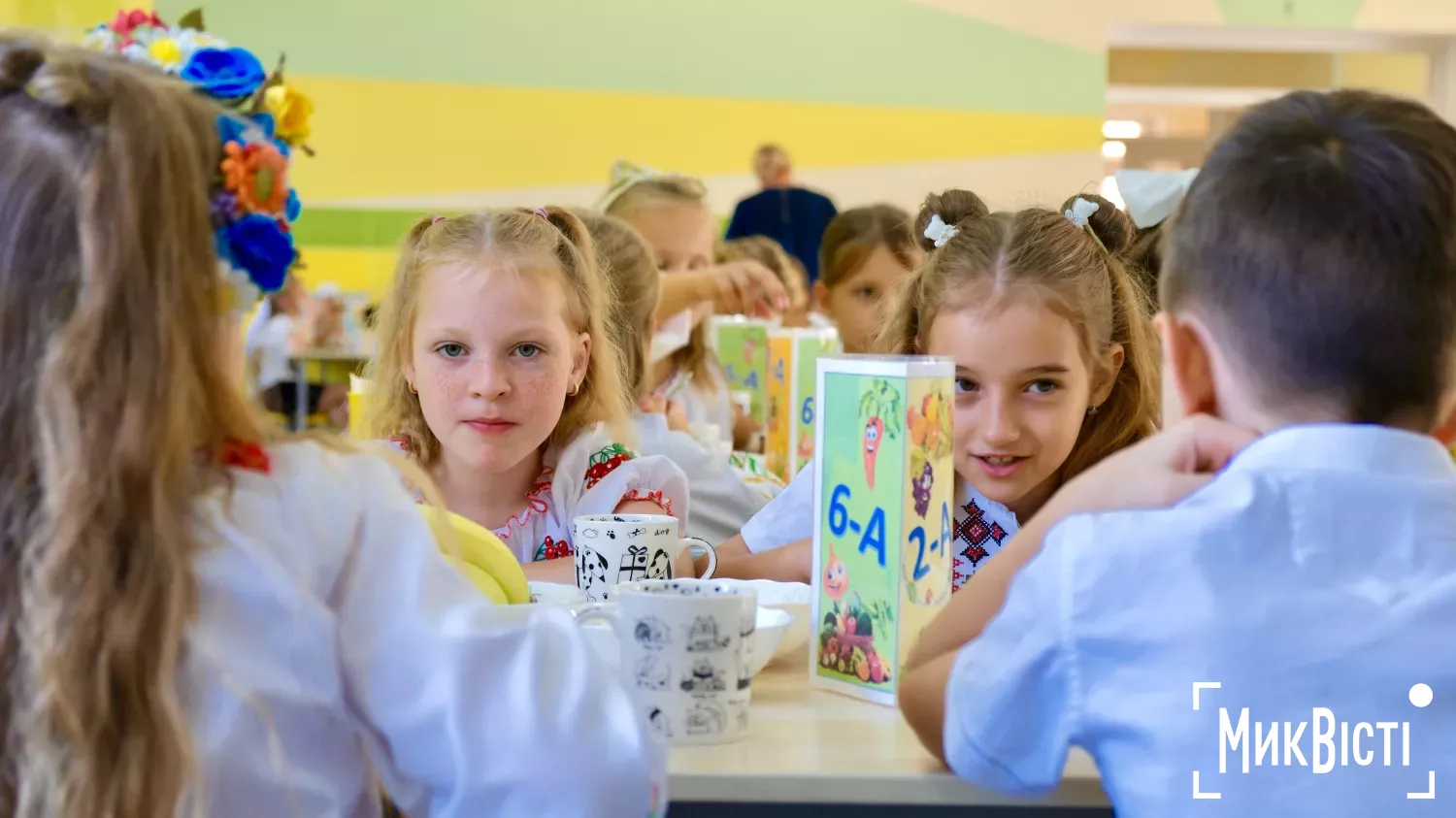 Why children with special educational needs in the Mykolaiv region cannot continue their education beyond Year 9. Photo: NikVesti
The full-scale war has exacerbated many problems in the Ukrainian education system, but for children with special educational needs, it can mean the effective loss of their right to an education. In the Mykolaiv region, parents of children with intellectual disabilities and autism spectrum disorders have found themselves in a situation where, after completing Year 9 at a special school, it becomes almost impossible to continue their education.
Over the past five years, 570 children have completed their full general secondary education at special schools in the region, 89 of whom have ASD. At the same time, in some communities, special schools do not have upper secondary classes, and there are virtually no alternative institutions.
In this article, NikVesti has investigated what educational opportunities exist for children with intellectual disabilities in the Mykolaiv region, what the Mykolaiv Regional Military Administration’s Department of Education and Science has to say on the matter, and how to protect a child’s right to education if it is being violated.
In Voznesensk, children with ASD cannot study up to Year 11. Why is this?
Under Ukrainian law, every child has the right to a full general secondary education. However, Kateryna Kovalova, a pupil at the Voznesensk Special School who has an intellectual disability, is unable to continue her education after completing Year 9. The school explains that it is unable to open Years 10 and 11 due to a shortage of teachers and teaching facilities.
According to the pupil’s mother, Maryna Kovaliova, she first learnt of the problem after the previous year’s graduation, when it became clear that, upon completing Year 9, pupils at the special school effectively had no opportunity to continue their education and were forced to stay at home. After that, she began looking for ways for her daughter to complete her full general secondary education.
«Previously, no school would accept such children at all. Last year was the first time such children had graduated. When they finished school, I learnt that after Year 9 they simply stay at home. I visited the inclusive resource centre and spoke to its headteacher. She asked, «What are you going to do after Year 9?» I replied, «What do we have in this town for children like this?» She said, «There’s nothing.» Then I asked the headteacher: «Why isn’t there a Year 10? Other schools have one.» She replied that there was no possibility of opening one,» says Maryna Kovaliova.
In total, nearly 240 children attend the special school in Voznesensk. There are between five and eight children in each class, where lessons are taught according to an adapted curriculum.
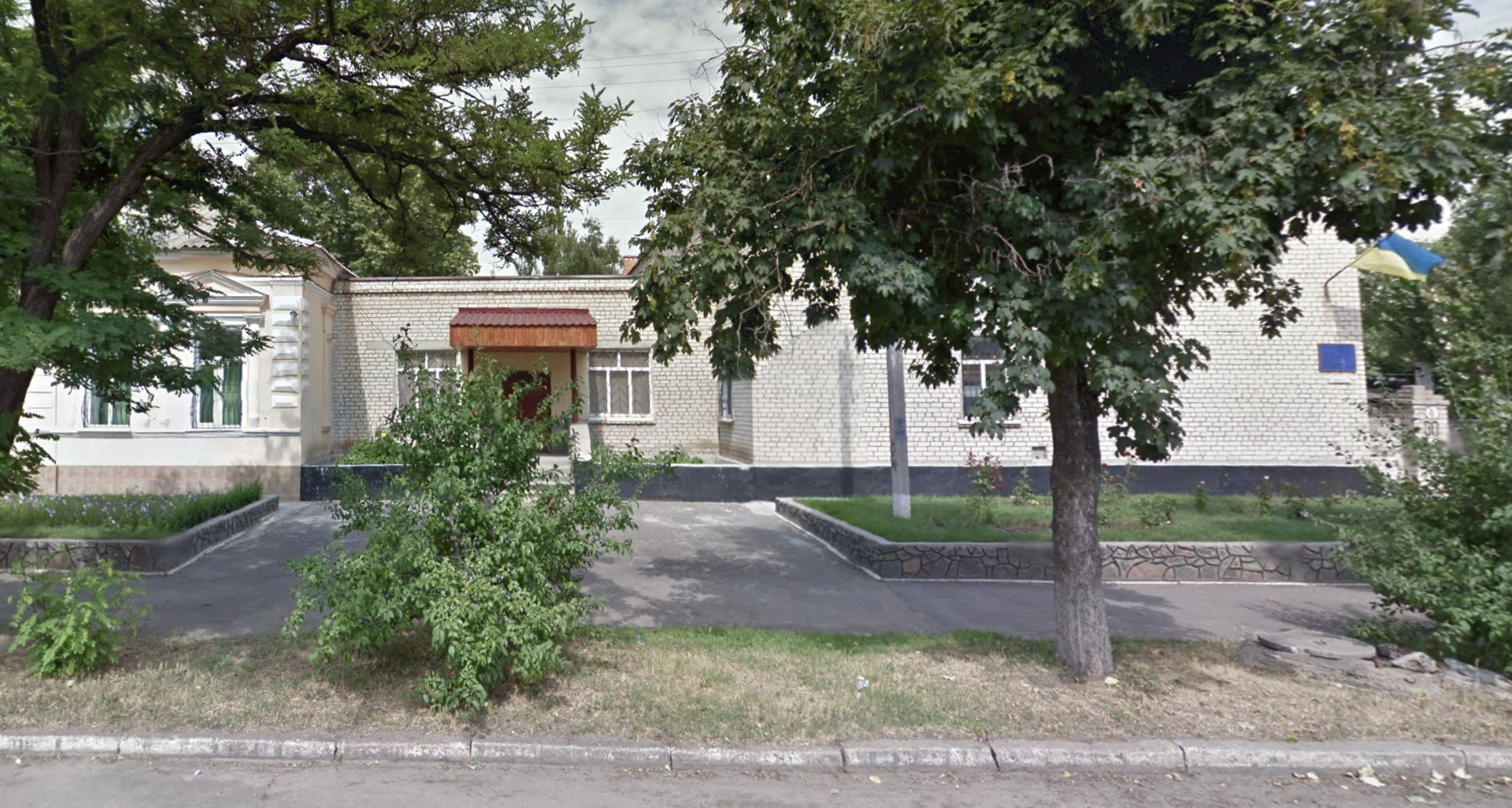 Voznesensk Special School. Screenshot from Google Maps
Maryna Kovaliova says that her daughter studied in a class for several years before switching to individualised learning. After Year 9, she planned for Kateryna to return to studying alongside her classmates, as this promotes socialisation.
Initially, she says, she wrote to the Ministry of Education and Science of Ukraine asking for clarification on where such children could continue their education after completing Year 9 at a special school.
In their reply, she was told that children could study at either special schools or mainstream secondary schools, and her enquiry was forwarded to the Department of Education and Science of the Mykolaiv Regional Military Administration so that the issue could be resolved locally.
«I received a phone call from the department and was told that this was a problem affecting the whole region and needed to be resolved. They assured me they would keep in touch. But then I received a written reply stating that such children, after completing Year 9 at a special school, cannot study anywhere at all, as this is not provided for by law. This is not true, as it effectively amounts to discrimination. How can it not be provided for? “All children have the right to a full general secondary education,» says Maryna Kovaliova.
Unsatisfied with this response, she wrote to the Ministry of Education and Science of Ukraine again. Following this, the Department of Education and Science of the Mykolaiv Regional State Administration proposed transferring her daughter to a mainstream secondary school. At the same time, the mother emphasises that this option does not meet her daughter’s educational needs, as she has moderate intellectual disabilities and requires special learning conditions.
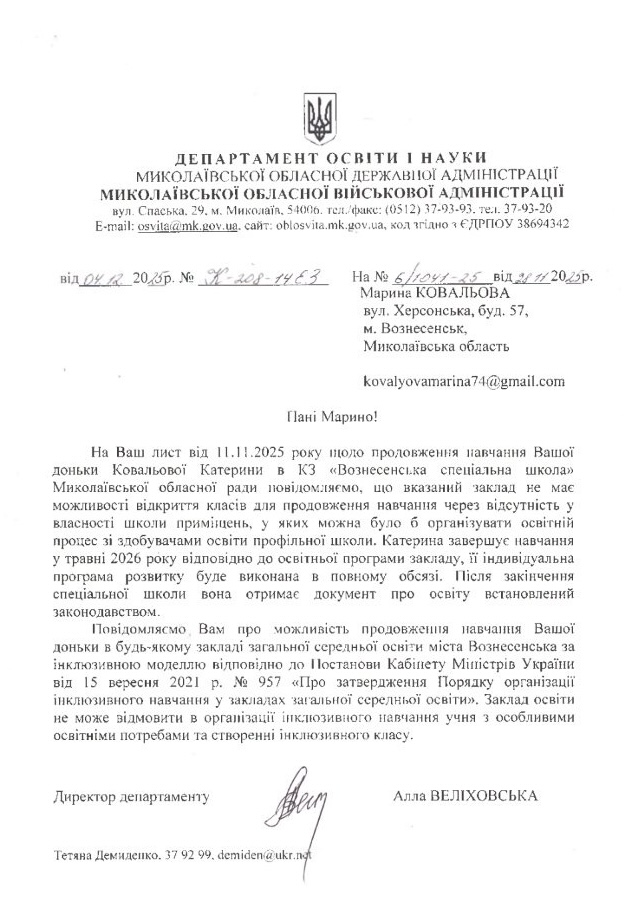 Response from the Department of Education and Science of the Mykolaiv Regional State Administration. Screenshot
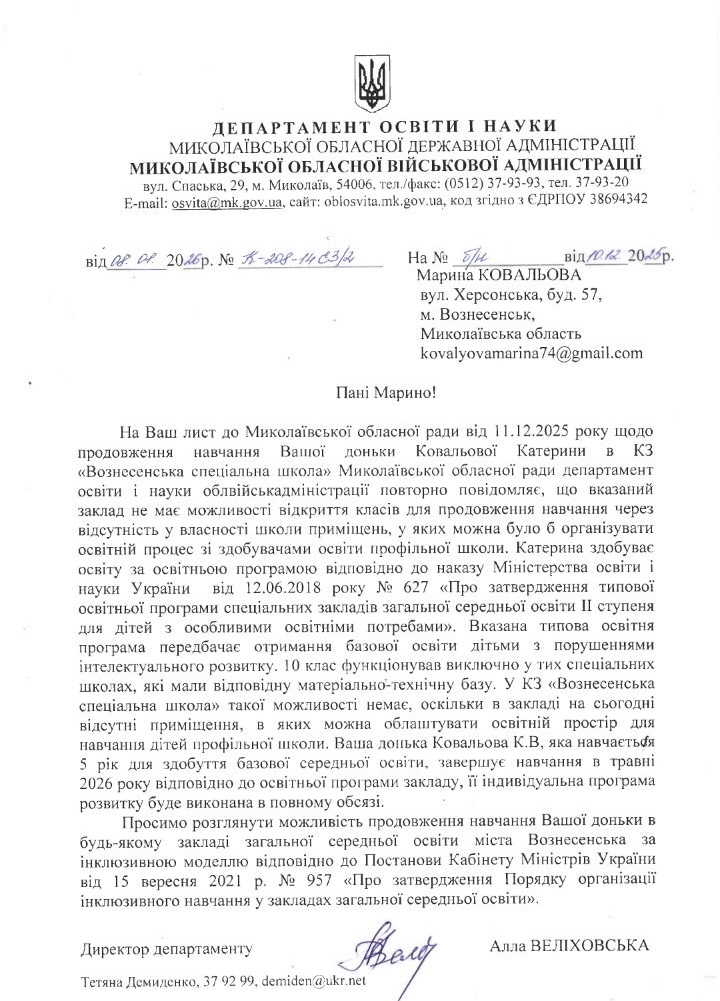 Response from the Department of Education and Science of the Mykolaiv Regional State Administration. Screenshot
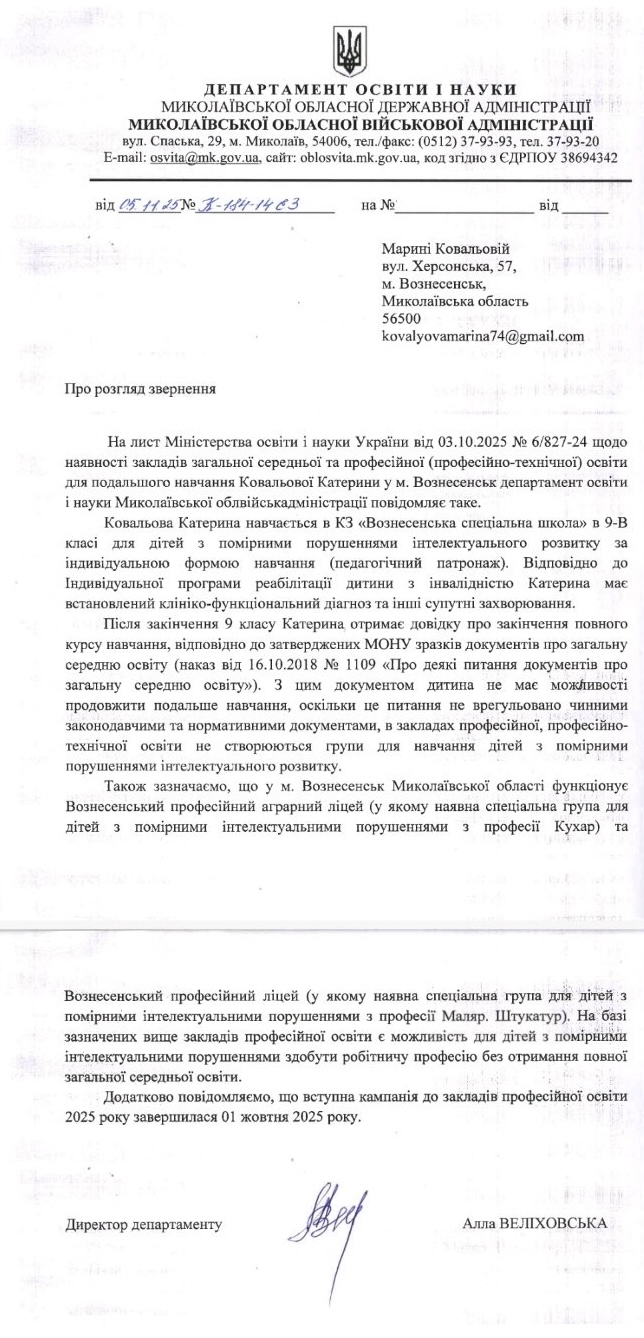 Response from the Department of Education and Science of the Mykolaiv Regional State Administration. Screenshot
The woman then appealed to the Mykolaiv Regional Council, as the founding body of the special school. However, she was informed that the relevant powers had already been transferred to the Department of Education and Science of the Mykolaiv Regional State Administration, so her appeal was referred back to that body. According to Maryna Kovaliova, the reply once again stated that it was not possible to open Years 10 and 11.
Subsequently, the woman submitted a petition to the Verkhovna Rada of Ukraine’s Temporary Investigative Commission on the Protection of Children’s Rights and re-applied to the Ministry of Education and Science of Ukraine.
«I wrote to Pavlo Sushko, Chair of the Verkhovna Rada’s Temporary Investigative Commission on the Investigation of Violations of Children’s Rights, via a messaging app, informing him that I had sent an email. He replied that they had seen the appeal and would deal with it in accordance with the requirements of current legislation. But four months have passed, and I still haven’t received a single reply,» says Maryna Kovaliova.
She also points out that in one of its official letters, the Department of Education and Science of the Mykolaiv Regional State Administration claimed that she had allegedly agreed to transfer her daughter to a mainstream school. According to her, she never gave such consent.
«In one of the letters, the Department wrote that I had allegedly agreed to transfer my child to a mainstream school. In fact, I did not give such consent. After I wrote to them again, they replied that it was merely a suggestion, not my consent. But as a result, they are once again suggesting that I transfer my child to a mainstream school,» the woman said indignantly.
Furthermore, according to the complainant, representatives of the Department had previously been trying to persuade her to transfer her child to a mainstream school and to have her attend only remedial classes at a special school for half a year.
«I received a call from the department and they started trying to persuade me to take my child to a mainstream school. They said that she would only be able to attend remedial classes at the special school, and only for half a year. ‘As for what to do next — that’s up to you,» the woman explained.
After publicising the situation on social media, the woman received a new response from the Ministry of Education, which had forwarded her complaint to the Mykolaiv Regional Military Administration for investigation.
In its reply, according to the complainant, the Ministry also noted that issuing her daughter with a certificate of basic secondary education upon completion of Year 9 at a special school did not comply with the requirements of the law.
The letter states that pupils at special schools for children with intellectual disabilities should be issued with such a certificate after completing Year 10, and for pupils studying under the New Ukrainian School programme, after Year 11. The Ministry also reported that the State Service for the Quality of Education had identified similar breaches as far back as 2025 and had provided the Department of Education with recommendations on how to rectify them.
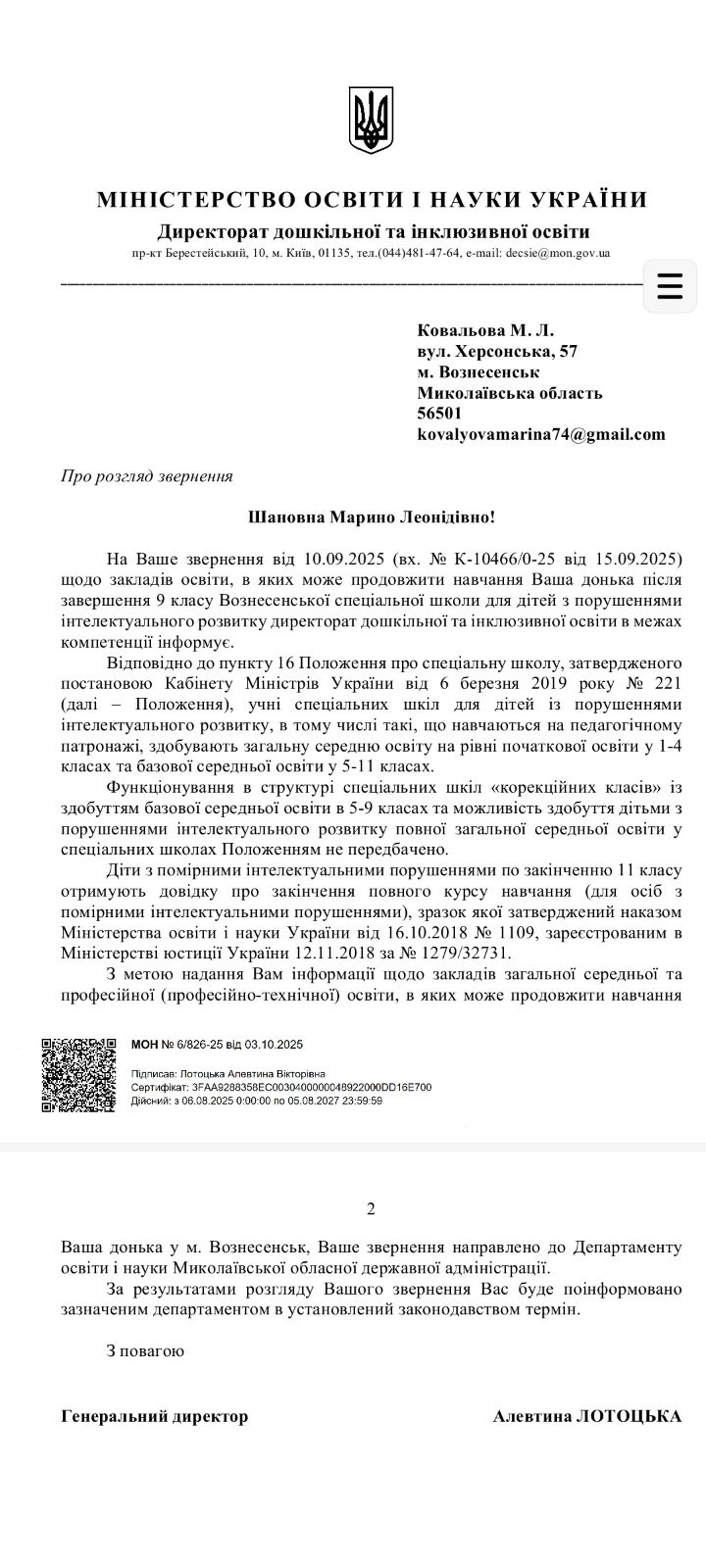 Response from the Ministry of Education and Science of Ukraine. Screenshot
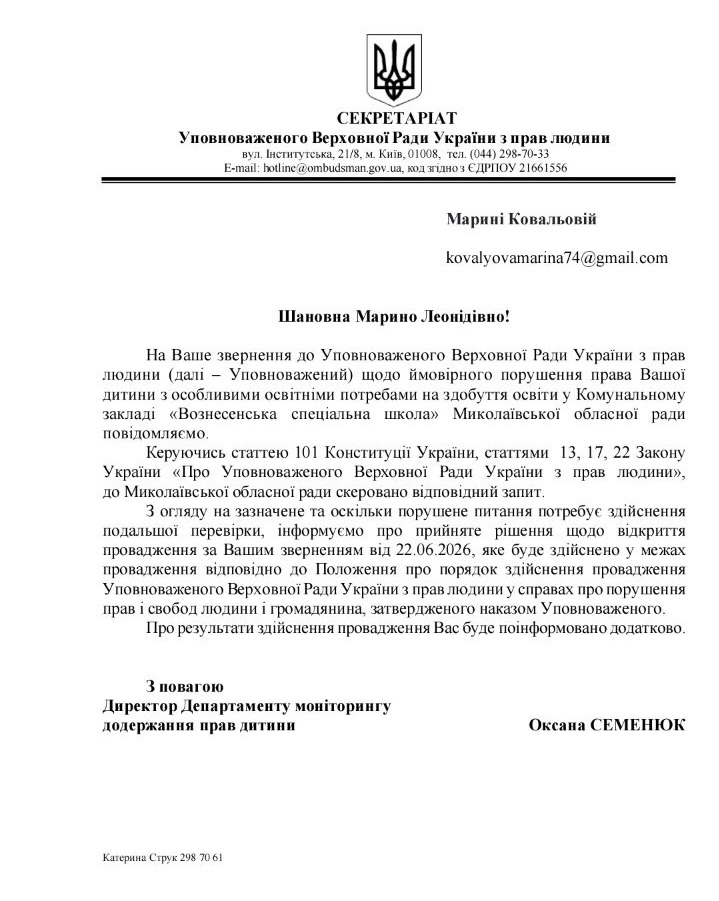 Response from the Ukrainian Parliament Commissioner for Human Rights. Screenshot
Hello! I am Darina Melnychuk, the author of this article.
Thank you for your attention to our texts — it means a lot to the NikVesti team.
We regularly publish in-depth materials for those who want to understand the topic and get to the heart of the matter.
We have dozens of examples when our journalism, together with our readers, has influenced situations and changed them.
Join the NikVesti Readers’ Club — support independent journalism that matters.
Support us by joining the NikVesti Club
At present, according to the mother, the issue of continuing the education of her daughter and other children who have completed Year 9 at a special school remains unresolved, even though there are less than two months to go before the start of the new academic year. That is why she is asking for a legal assessment of the situation and clarification on how the right of such children to receive a full general secondary education should be ensured.
«In our town, there is no alternative to the special school for such children. I am not asking for any special privileges. I am asking that my child’s right to education, guaranteed by the Constitution of Ukraine and the laws of Ukraine, be ensured. What worries me most is that there is very little time left before the start of the new academic year, and the issue of my daughter’s education has still not been resolved,» said the woman.
In response to the mother’s appeal, Voznesensk Special School reported that preparations for the new academic year are currently underway: a network of classes is being organised, the school’s operating arrangements are being finalised, and organisational decisions are being taken.
Once these procedures are complete, parents will be informed in writing about the further organisation of schooling. However, the response did not specify whether children with intellectual disabilities would be able to complete their full general secondary education (Years 10–11) in the 2026/2027 academic year.
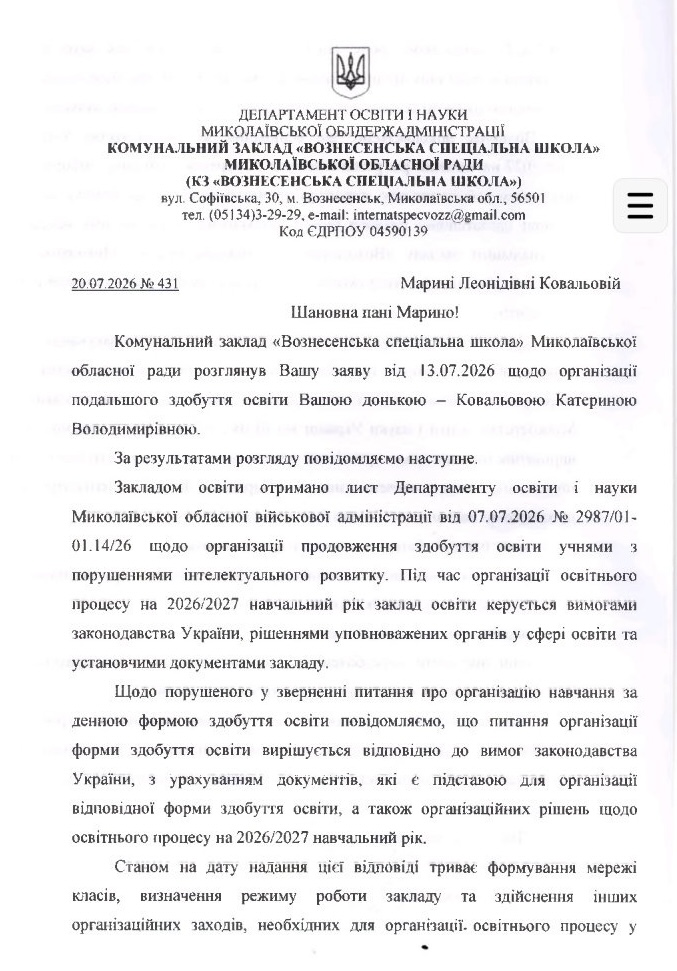 Response from the ‘Voznesensk Special School’ regarding the organisation of teaching for Years 10–11. Screenshot
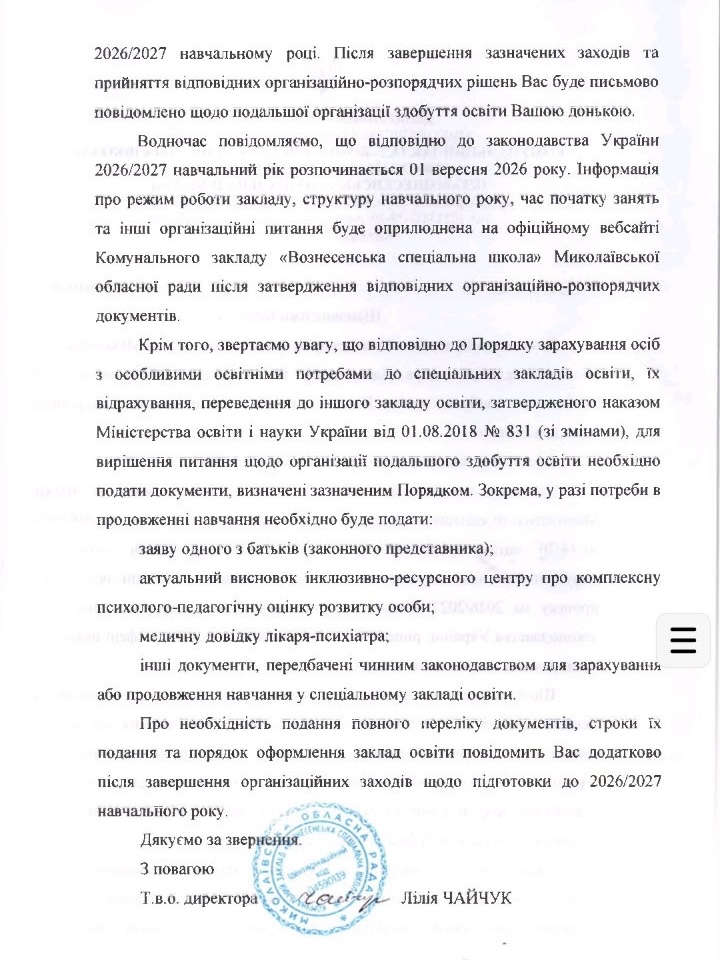 Response from the Voznesensk Special School regarding the organisation of education for Years 10–11. Screenshot
There are only four schools with special classes in the region
In the Mykolaiv region, special classes for children with intellectual disabilities and autism spectrum disorders, specifically for Years 5–11, operate in only four general secondary schools.
These figures were provided by Alla Velikhovska, Director of the Department of Education and Science of the Mykolaiv Regional State Administration, in response to an information request from ‘NikVesti ’.
Specifically, one special class operates at the Stavkiv Lyceum in the Veselynivska community, where five pupils are enrolled. In the 2024–2025 academic year, five pupils graduated from the school with a basic general secondary education.
 Pupils at Mykolaiv Lyceum No. 55. Illustrative photo: NikVesti
There is also one special class each at Gymnasiums №13 and №17 in Mykolaiv. At Gymnasium №13, №11 pupils completed their basic general secondary education in the 2025–2026 academic year, and at Gymnasium №17, eight did so.
At Mykolaiv Gymnasiums №43, №46 and №53, as well as at the Pivdennoukrainsk Lyceum №1 named after the Defenders of the Fatherland, special classes operate only at primary school level.
Two further special classes are in operation at the Pivdennoukrainsk Lyceum №1 named after the Defenders of the Fatherland, attended by 18 pupils. At the same time, it is noted that over the past five years, not a single pupil with intellectual disabilities or autism spectrum disorders in the South Ukrainian community has completed their general secondary education.
The department also reported that there are eight special schools under regional jurisdiction operating in the region: three in Mykolaiv, as well as in Voznesensk, Pervomaisk, Shyrokolanove, Ratsynska Dacha and Novopetrivka.
Teaching in special schools is carried out in accordance with state educational programmes for children with intellectual disabilities. In addition to general education subjects, pupils attend remedial and developmental classes, and the educational process is organised in accordance with the model curricula approved by the Ministry of Education and Science of Ukraine.
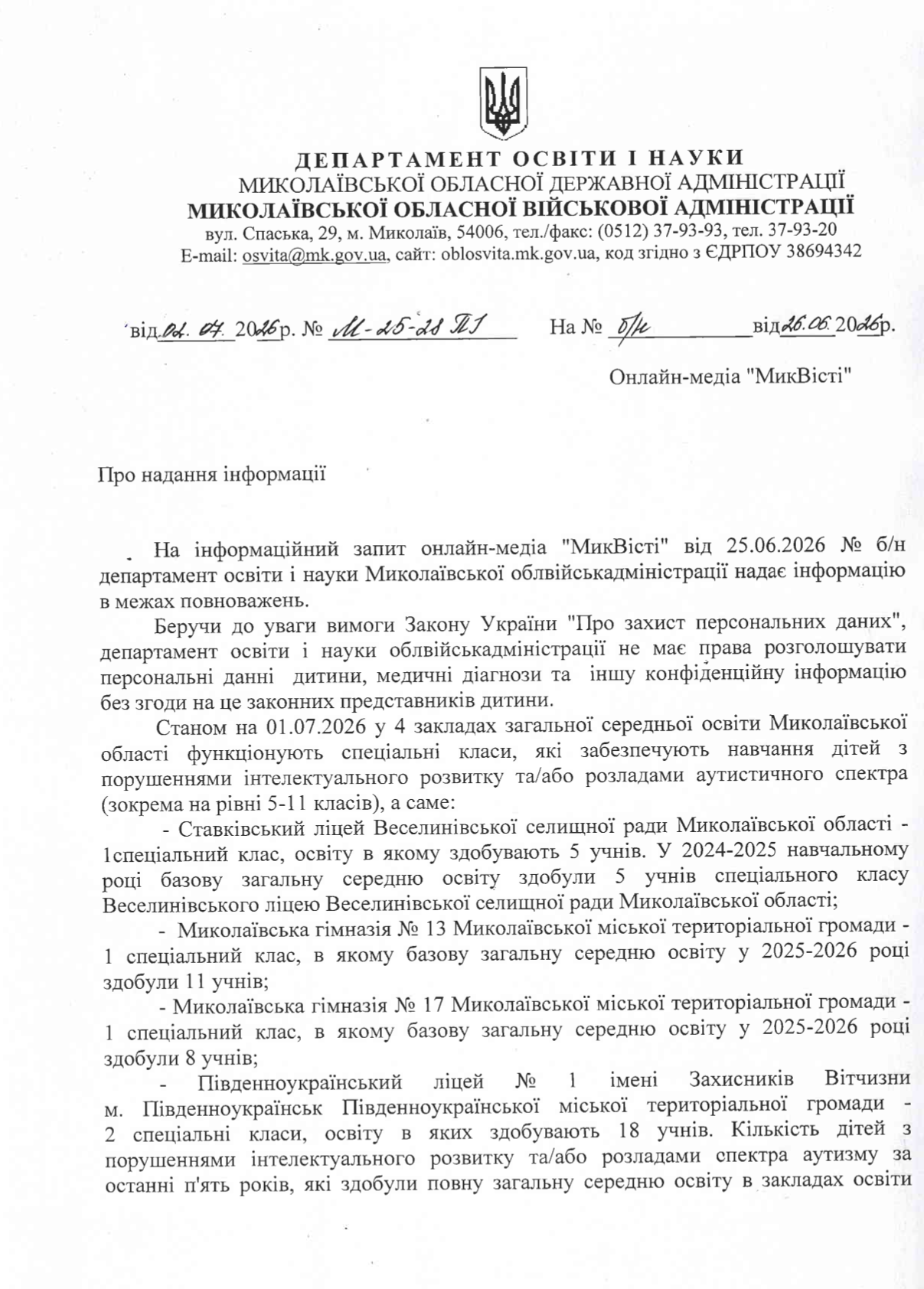 Response to an information request from the Department of Education and Science of the Mykolaiv Regional State Administration
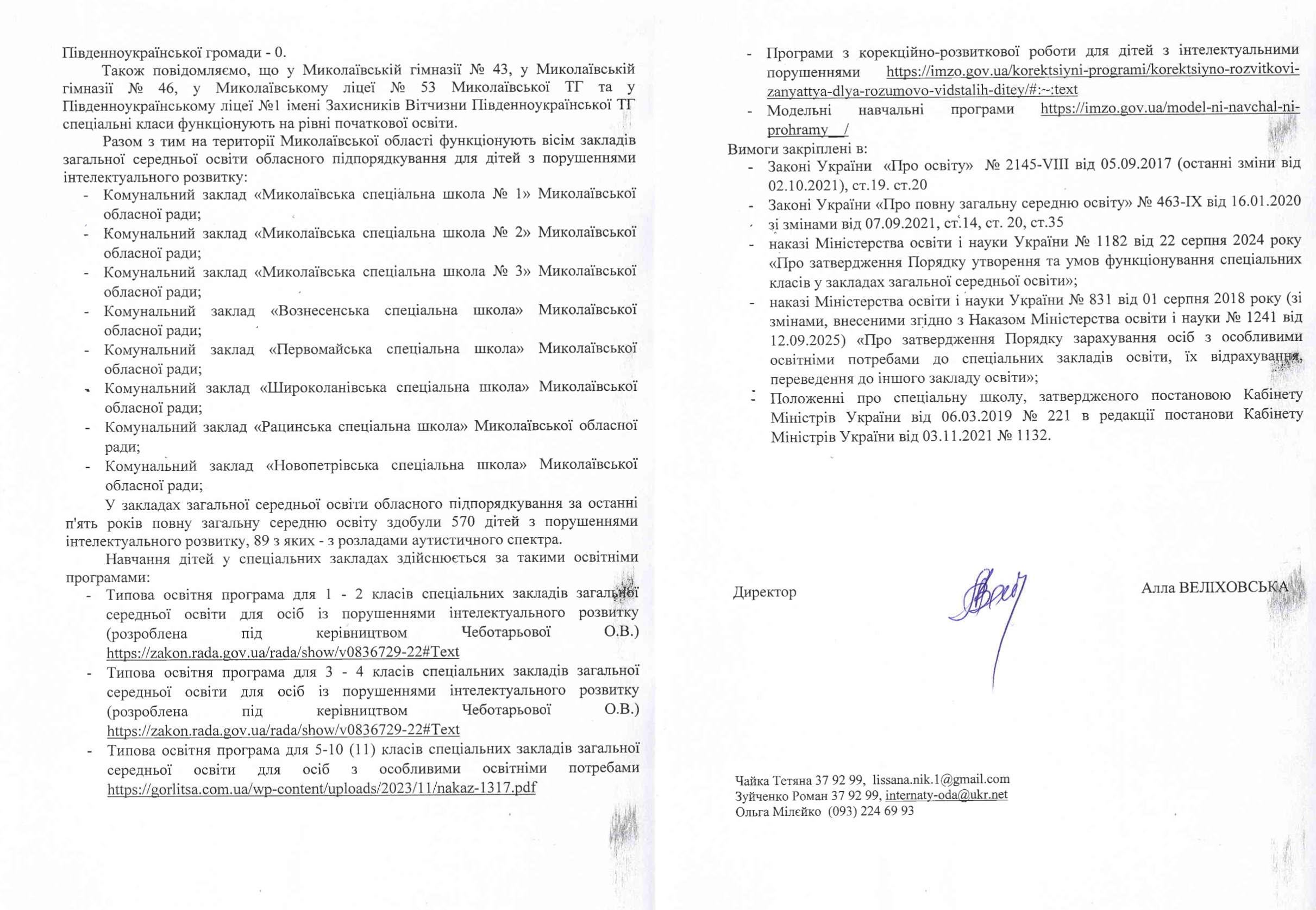 Response to an information request from the Department of Education and Science of the Mykolaiv Regional State Administration
Violation of the right to education: advice from the Ombudsman’s representative
Vasyl Donets, the representative of the Ukrainian Parliament Commissioner for Human Rights in the Kherson and Mykolaiv regions, notes that if a child is effectively unable to continue their education due to a lack of the necessary conditions, this may indicate a violation of the right to education and the principle of equal access to it.
«Speaking generally about inclusion and accessibility, this applies not only to children with disabilities, but to everyone. We say we are moving towards Europe, we pass laws, and we have national building regulations on accessibility. But this is more like empty slogans, because in reality things are different. And the case you are referring to confirms this. The law stipulates one thing, the Ministry says that’s how it should be, but in practice people do not receive what they are entitled to,» said Vasyl Donets.
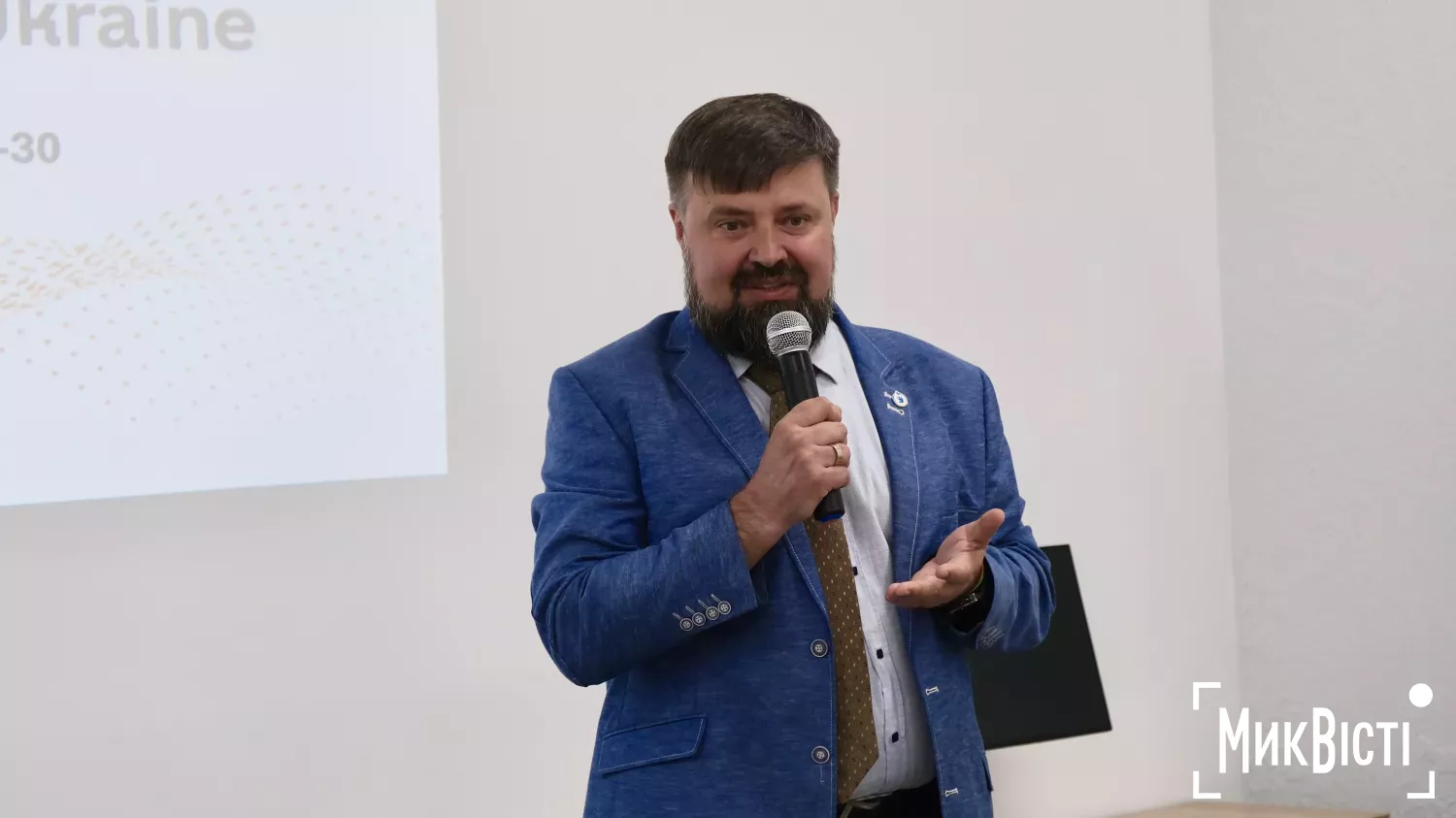 Vasyl Donets, representative of the Ukrainian Parliament Commissioner for Human Rights in the Kherson and Mykolaiv regions, during the presentation of the annual report on the state of observance of human and civil rights and freedoms in Ukraine for 2025. Photo: NikVesti
He added that the lack of specialised classes could be regarded as discrimination against children with disabilities if they are effectively denied the opportunity to continue their education.
«This demonstrates the ineffectiveness of the state authorities. The Ministry says it is taking action, and local authorities are also supposed to fulfil their responsibilities, but ultimately we are seeing discrimination against people with disabilities who are unable to continue their education. This is shameful,» emphasised Vasyl Donets.
According to him, in the event of a human rights violation, one can appeal to both the relevant committees of the Ministry of Education and Science and the Office of the Ukrainian Parliament Commissioner for Human Rights.
«There are ministerial committees and our institution, which people can turn to. We have the tools to restore rights that have been violated. Usually, when people sit down at the negotiating table and start resolving such issues, it turns out that things aren’t that complicated and don’t require an enormous amount of funding. There are many international organisations that can help, and there are resources available within local communities. The main thing is that there is a willingness to do so,» noted the Commissioner’s representative.
Furthermore, Vasyl Donets explained that if a human rights violation is confirmed and the relevant authority fails to remedy the violation following an intervention by the Commissioner, measures provided for by law may be applied against the official, including the drawing up of an administrative report.
«Our aim is to restore the violated right. If a state body fails to restore it, then consequences will follow in accordance with current legislation. We have the power to draw up a report. Following its consideration in court, the offender may be fined. But our primary task is to ensure that the right is restored. That is precisely why we send a letter demanding that the violation be rectified,» he said.
If the authority responds to the complaint and restores the infringed right, the Ombudsman’s Office’s work is effectively concluded.
How do you submit a complaint to the Human Rights Commissioner?
There are several ways to contact the Representative Office of the Ukrainian Parliament’s Human Rights Commissioner in the Mykolaiv region.
In particular, a short hotline number, 1678, has been operational since 1 May, which citizens can use to report possible violations of their rights. Complaints are also accepted by email, post or in person at the regional office.
«A person comes in, explains their problem and writes a complaint. We register it, and it is entered into the electronic database. A staff member is then assigned to handle the complaint. The Commissioner’s office is divided into nine areas of work, so depending on which specific right may have been violated, the complaint is forwarded to the relevant specialist,» explained Vasyl Donets, Representative of the Ukrainian Parliament Commissioner for Human Rights in the Kherson and Mykolaiv regions.
The relevant specialists then send enquiries to the relevant authorities, receive replies and determine whether a right has indeed been violated.
At the same time, Vasyl Donets noted that not every complaint confirms that a human rights violation has taken place.
«If we conclude that no rights have been violated — and such cases do occur — we inform the complainant. Sometimes people think that if they don’t like something, it automatically means the law has been broken. But that is not always the case,» he said.
Furthermore, according to Vasyl Donets, in accordance with the Law of Ukraine «On Citizens’ Complaints», anonymous complaints are not considered.
«There have been cases where a complainant came in and said: «You should have replied to me by now.» We checked our database and saw that a reply had already been prepared and sent, but it had not yet reached the person by post. In general, all appeals are considered, and applicants are guaranteed a reply,» concluded the Commissioner’s representative.
The story of the family from Voznesensk shows that even when the right to education is guaranteed by the Constitution and the laws of Ukraine, its realisation in practice may depend on the availability of teachers, classrooms and decisions by local authorities.
At the same time, as emphasised by the representative of the Ukrainian Parliament’s Commissioner for Human Rights, in the event of a violation of this right, parents can turn to the Ombudsman’s Office, which has mechanisms in place to protect it. Whether a solution can be found before the start of the new academic year for children who have already completed Year 9 at a special school remains an open question.


