The Mykolaiv Regional Council will be training its councillors on how to act with integrity
-

- Alina KvitkoReporter
-
 5000 +
Impressive! This content has been viewed by more than 5,000 visitors!
5000 +
Impressive! This content has been viewed by more than 5,000 visitors!
-
 Prefer on Google
-
5K
Impressive! This content has been viewed by more than 5,000 visitors!
-
Prefer on Google
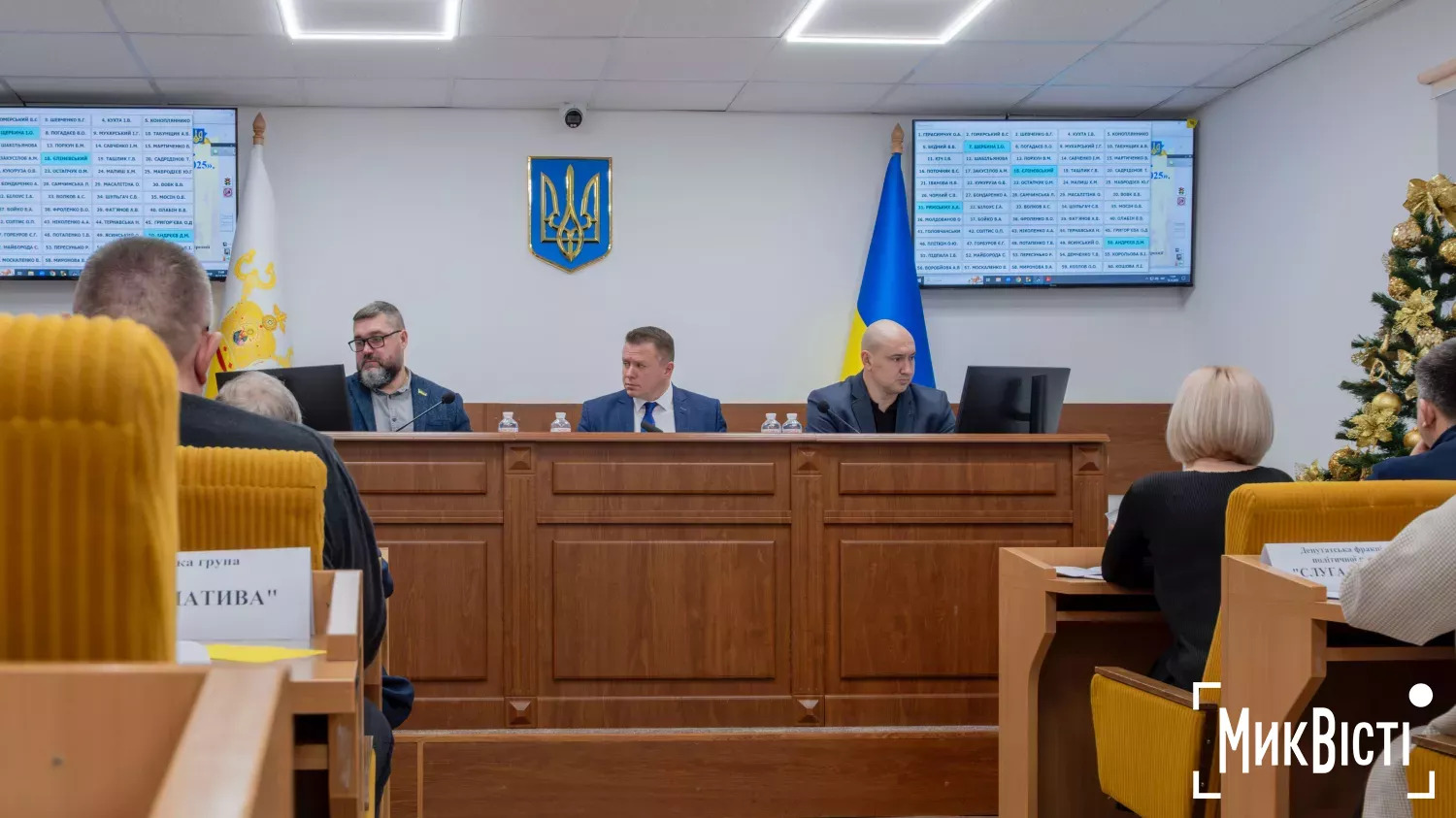 A session of the Mykolaiv Regional Council. Photo: NikVesti archive
Members of the Mykolaiv Regional Council will undergo training to avoid corruption risks in their work. This is part of a new anti-corruption programme for 2026–2028, which has identified 19 potential problem areas.
This was discussed on 3 April at a meeting of the Committee on Regional Development, Planning, Budget, Finance and Investment, NikVesti reports.
The draft programme was presented by Tetiana Labartkava, the administrative manager of the regional council’s executive office. According to her, the development of the new document is linked to the expiry of the previous programme, which was approved in September 2023. Under the law, the new action plan must be adopted within four months of the previous one’s expiry.
Tetiana Labartkava reported that preparatory work had been ongoing since October 2025. The working group assessing corruption risks included representatives of parliamentary factions, groups and the public.
«Extensive work was carried out, and the composition of the working group was updated. An assessment of corruption risks was conducted and a register comprising 19 items was drawn up. These cover almost all areas of the Mykolaiv Regional Council’s activities,» noted Tetiana Labartkava.
The document has passed the public consultation stage — the draft was published on the regional council’s website on 4 March, and the matter will now be put forward for consideration at the 35th extraordinary session of the Mykolaiv Regional Council.
Immediately after the session adopts the decision, the text of the programme will be sent to the National Agency for the Prevention of Corruption (NAPC) for approval within three working days.
The draft programme includes a register of 19 corruption risks that may arise in the work of the regional council. These cover almost all key areas — from the activities of councillors, staffing decisions and financial control to procurement, management of community assets, document flow and access to public information.
Risk №1: Dishonesty on the part of regional council members in the performance of their duties, manifested in the potential use of their mandate for personal or self-serving purposes, the adoption of decisions contrary to the interests of the community, and voting in situations of actual or hidden conflicts of interest; this risk is rated at 6 points, and to minimise it, training for councillors and ensuring full transparency of proceedings through the publication of draft decisions and video recordings of meetings are envisaged.
Risk №2: Potential influence by third parties on the drafting of the agenda for plenary sessions through the granting of unjustified priority to certain issues, in particular by using the «urgency» procedure without proper grounds; this is rated at 4 points and requires constant monitoring of compliance with the Rules of Procedure and a quarterly analysis of the status of document processing.
Risk №3: A formalistic approach to the implementation of anti-corruption measures, which may lead to the ineffectiveness of the corruption prevention system and the concealment of offences; the risk is rated as medium (4 points) and requires ensuring the full independence of the authorised person and regular audits of their activities.
Risk №4: Failure to ensure the functioning of internal reporting channels and the protection of whistleblowers, in particular due to a lack of connection to the Unified Whistleblower Portal, which is rated at the maximum 9 points and requires immediate connection to the NACP system and the conduct of awareness-raising activities among staff.
Risk №5: Deliberate failure to submit, late submission of declarations, or the inclusion of false information regarding financial status by MPs and officials with the aim of concealing income, which is a critical risk rated at 9 points and requires systematic verification of e-declarations in the state register and the provision of advisory assistance.
Risk №6: The likelihood of an official receiving an unlawful benefit for concealing breaches of financial control by other declarants, which is low (1 point) and is managed through rigorous record-keeping of all declarations and reminders regarding personal accountability.
Risk №7: Favouritism in the recruitment of staff for the executive apparatus, particularly under the simplified procedures of martial law, which is rated at 2 points and requires monitoring of appointments and preventive interviews with candidates regarding conflicts of interest.
Risk №8: Misconduct in the appointment of heads of community-owned healthcare facilities, where commission members may favour certain candidates; this is rated at 3 points and requires the implementation of internal controls over selection procedures.
Risk №9: Misuse or lack of transparency in the use of financial resources allocated for the maintenance of the regional council, rated at 2 points and requiring strict accounting controls, approval of budgets in accordance with the law, and regular monitoring of expenditure.
Risk №10: Potential influence by interested parties on council representatives in courts with the aim of securing unlawful decisions in favour of third parties, rated at 2 points and minimised through control of procedural actions and monitoring of court decisions.
Risk №11: Receipt of undue advantage for the preparation of biased legal opinions on draft decisions or contracts, rated at 3 points and requiring the results of the legal review to be brought to the attention of the relevant committee.
Risk №12: Granting undue advantages when leasing municipal property or establishing preferential terms for related parties, which requires ensuring full transparency of tender procedures and the publication of information on available premises.
Risk №13: Abuse of authority during the registration and allocation of community property, rated at 2 points and planned to be addressed by creating a public electronic property register in the second half of 2027.
Risk №14: The risk of concealing or falsifying incoming correspondence and unjustified refusals to provide public information, which is rated as low (1 point) and is prevented through quarterly monitoring of the electronic document management system.
Risk №15: Deliberate overstatement of the expected value of procurements or the volumes of goods and services to obtain kickbacks, which is rated at 2 points and requires prior monitoring of market prices before tenders are announced.
Risk №16: Setting discriminatory conditions in tender documentation to ensure the victory of a pre-determined participant, rated at 2 points and requiring mandatory approval of the documentation by the legal department to check for corruption-inducing factors.
Risk №17: Signing certificates of completion and payment for services that were not actually provided or were provided only in part, rated at 2 points and requiring an internal audit and personal accountability for technical supervision.
Risk №18: Appointment of individuals to positions in breach of the procedure for conducting special checks or without such checks at all, which is rated at 2 points and requires an annual audit of personnel orders and strict adherence to the regulations governing special checks.
Risk №19: Deliberate non-publication or untimely publication of council decisions and video recordings of meetings to conceal conflicts of interest, rated at 4 points and requiring the implementation of an internal publication schedule with personal accountability for each section of the website.
Mykolaiv Integrity Plan
In June 2024, a working group was set up in Mykolaiv to develop the City Council’s «Integrity Plan». The document assesses six areas: procurement, land assets, infrastructure, local self-government, ethics and anti-corruption, and is intended to reduce the risks of favouritism and corruption among councillors and officials, particularly in the management of municipal property.
In 2025, during a discussion of the draft at the Committee on Legal Affairs, the head of the anti-corruption department stated that public consultations had allegedly already taken place, yet the group consisted of only 10 city hall officials, with no representatives from the public or the media. This drew criticism.
According to recommendations from EUACI and UNDP, independent experts, the media and civil society organisations should be involved in drafting such documents. Councillors refused to adopt the Plan without a proper discussion, and the Public and Expert Council held an alternative discussion.
The NikVesti media outlet proposed its own amendments, in particular:
- transparency of remote meetings via live cameras;
- constant physical access for journalists to the city council.
EU Ambassador Katarina Maternova described Mykolaiv as an «integrity-driven» city, highlighting the favourable conditions for partners.
As of December 2025, the Department of Anti-Corruption Policy had not responded to the proposals from councillors and experts. Mayor Oleksandr Sienkevych called for support for the Plan, emphasising its importance for international partners, and expressed outrage at the delay in the document’s consideration by the relevant committees.


The NGO “Mykolaiv Media Hub” (online media outlet NikVesti) wishes to acknowledge the financial assistance of the European Union through its project “Frontline and Investigative Reporting Media in Ukraine” (FAIR Media Ukraine), implemented by Internews International in partnership with the Media Development Foundation (MDF). The NGO “Mykolaiv Media Hub” (online media outlet NikVesti) retains full editorial independence, and the information presented here does not necessarily reflect the views of the European Union, Internews International, or MDF.