Kim stated that the Mykolaiv Alumina Plant would be one of the first sites to attract investors after the war
-

- Alina KvitkoReporter
-
 3000 +
Wow! Over 3,000 visitors have viewed this content!
3000 +
Wow! Over 3,000 visitors have viewed this content!
-
 Prefer on Google
-
3K
Wow! Over 3,000 visitors have viewed this content!
-
Prefer on Google
 Vitaliy Kim has outlined two possible scenarios for the future of the Mykolaiv Alumina Plant after the war. Photo: NikVesti archive
Once the war is over, the Mykolaiv Alumina Plant could become one of the first industrial facilities to attract investors, as well as reorient itself towards European and US markets or serve as the basis for the construction of an aluminium plant.
This was stated by Vitalii Kim, head of the Mykolaiv Regional State Administration, in an interview with «Interfax-Ukraine».
He recalled that during the time when the plant was part of Russian oligarch Oleh Derypaska’s production chain, the Mykolaiv Alumina Plant (MAP) served merely as an intermediary between extraction and the end consumer, but such a «raw materials model» is not beneficial for Ukraine.
«We did not allow the entire enterprise to be plundered; there were even two criminal cases. Previously, when Derypaska (Russian oligarch Oleh Derypaska — IF-U) was building his chain, the Mykolaiv Alumina Plant was an intermediate stage between production and the end consumer. The raw materials model is not very profitable for Ukraine. Among the plans was the construction of a plant based at the Zaporizhzhia Aluminium Plant. And they even sold it to him (Derypaska — IF-U), but then they couldn’t agree on the price of electricity, and the project stalled,» noted Vitalii Kim.
Vitalii Kim also reported that, prior to the full-scale war, investors had already shown interest in MAP, specifically analysing the possibility of sourcing raw materials from the African market. However, he said, it is now impossible to implement such logistics due to the blockage of sea routes.
«There are two options moving forward: to supply products manufactured at the MAP, shifting focus from the Russian market to the European or American markets, or to build our own aluminium plant,» he said.
Vitalii Kim believes that the plant could become part of a future industrial cluster in the Mykolaiv region. He emphasised that the region has ambitions to become an energy hub, which opens up opportunities for large-scale production.
According to him, the construction of an aluminium plant will require at least 1 GW of electricity, and the Mykolaiv region has the potential to provide such volumes.
«I am confident that this needs to be done here, locally, to ensure competitiveness. Furthermore, an aluminium plant requires at least 1 GW of electricity, which has to come from somewhere. And we have the opportunity to build a fourth unit at the nuclear power station, which is precisely one gigawatt. In other words, everything is in place for this to be done in our region, but the war must end first,» he noted.
Kim added that the State Property Fund is currently the governing body of the Mykolaiv Alumina Plant. It is the Fund that is conducting negotiations with potential investors who are visiting and inspecting the plant.
At the same time, the head of the Regional State Administration emphasised that decisions regarding the future of the Mykolaiv Alumina Plant can only be made once the war is over.
«The State Property Fund is currently the governing body, and they are the ones talking to investors. Investors are coming to look at the plant, but we understand clearly that this cannot be realised whilst the war is ongoing. I believe the Mykolaiv Alumina Plant will be one of the first assets to attract interest once the war is over,» he said.
It should be noted that the State Property Fund plans to put the Mykolaiv Alumina Plant up for auction in the fourth quarter of 2026 with a starting price of $86 million. The head of the State Property Fund named the US and India as potential investors.
In addition, the State Property Fund commented that the Mykolaiv Alumina Plant will be put up for sale together with the plant’s sludge storage facilities, where alumina production waste is stored.
It should be noted that in the two years since the confiscation of the Mykolaiv Alumina Plant, the State Property Fund has done nothing to resolve the environmental issue regarding the sludge.
The Mykolaiv Alumina Plant — an environmental «time bomb»
Having been out of operation for five years now, the plant has become far more dangerous to the environment than it was when operating at full capacity. This view was expressed by the head of the State Environmental Inspectorate, Ihor Zubovych, in response to an information request from NikVesti regarding the situation at the Mykolaiv Alumina Plant since the start of the full-scale war.
According to the information that NikVesti received from the State Environmental Inspectorate, on 19 July 2022, the Mykolaiv Alumina Plant reported that, due to shelling in the vicinity of sludge storage facility №2, the processing of the surface of the deposited red sludge in the facility’s basins had been hampered, giving rise to risks of red sludge dusting.
As a result, the company is treating only a third of the area of sludge storage facility №2: «hostilities in the vicinity of sludge storage facility №2 and damage to the dust suppression system lines, making their repair difficult; the inability to service the dust suppression system due to the freezing of the company’s accounts. At the same time, maintenance of sludge storage facility №1 is being carried out in full by wetting the area using the company’s own resources.»
Twice in August 2022, once in September 2022 and once in January 2023, MAP reported that, due to increased wind speeds, uncontrolled dust emissions were observed from one of the slurry ponds, which could have caused contamination of land plots outside their sanitary protection zone. The company then activated the dust suppression system at sludge storage facility №2.
However, due to a shortage of staff, the company was unable to carry out dust suppression work on the banks of sludge storage pond №1.
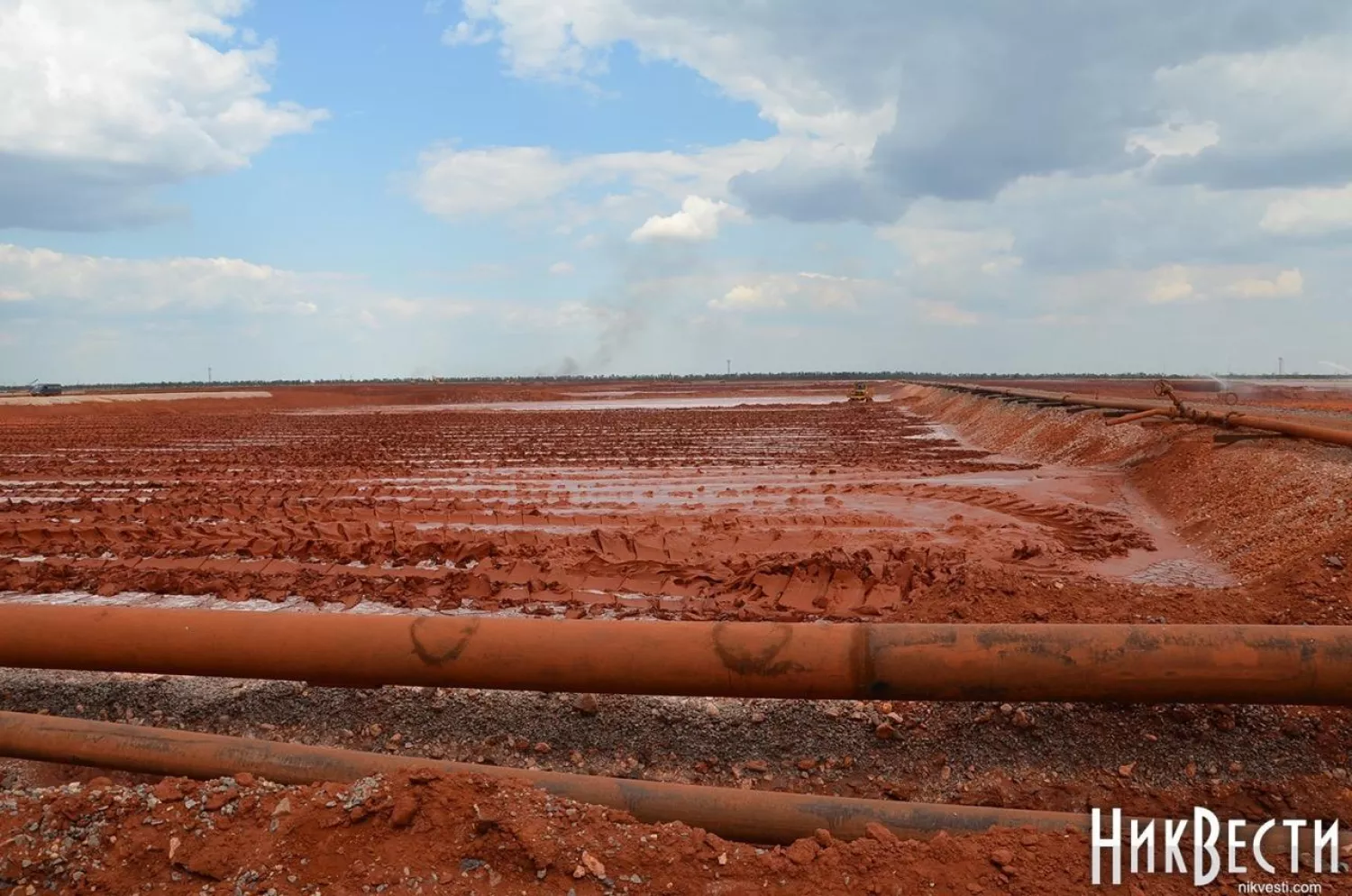 Sludge fields must be constantly moistened and the water beneath the sludge pumped out to avoid an environmental disaster, archive photo NikVesti
Uncontrolled dusting of sludge from the company’s sludge fields continued throughout 2023: in May, July, August (twice) and September (four times).
Until July 2022, maintenance work on the dust suppression systems at sludge storage facility №2, including the restoration of the system following shelling, was carried out by a contractor, which ceased providing services because MAP had not paid them for their work for almost six months.
In the spring of 2023, operations at the company’s sludge storage facilities became critical:
- the level of slurry water in the working basin of sludge storage facility №1 exceeded the permissible limit, posing a risk of pollution to the waters of the Bug Estuary, located 300 metres from the sludge field.
- The accumulation of sludge at sludge storage facility №2 has reached a critical level, with a higher alkalinity than at sludge storage facility №1. Overflowing of this storage facility will lead to the contamination of the agricultural land adjacent to it.
- The problem of significant dusting from the sludge in Field №2 persists, which may cause air pollution. This is due to the fact that a «dry» storage method is used there, which requires constant monitoring and moistening of the surface.
- The sprinkler system for dust suppression (necessary for moistening the sludge), which was in operation at the plant, was damaged and rendered inoperable during the hostilities.
In July 2025, the State Environmental Inspectorate of the South-Western District informed the Minister of Economy and Environment that the waste situation at the Mykolaiv Alumina Plant was deteriorating. Environmentalists warned of the risk of a sludge storage breach and pollution of the Bug Estuary.
On 26 April 2026, storm winds began to scatter sludge from the Mykolaiv Alumina Plant’s sludge storage facilities across the outskirts of Mykolaiv — waste left over from the processing of bauxite into alumina.
That evening, the Mykolaiv Regional State Administration assured the public that the situation at the plant’s sludge fields had been brought under control.
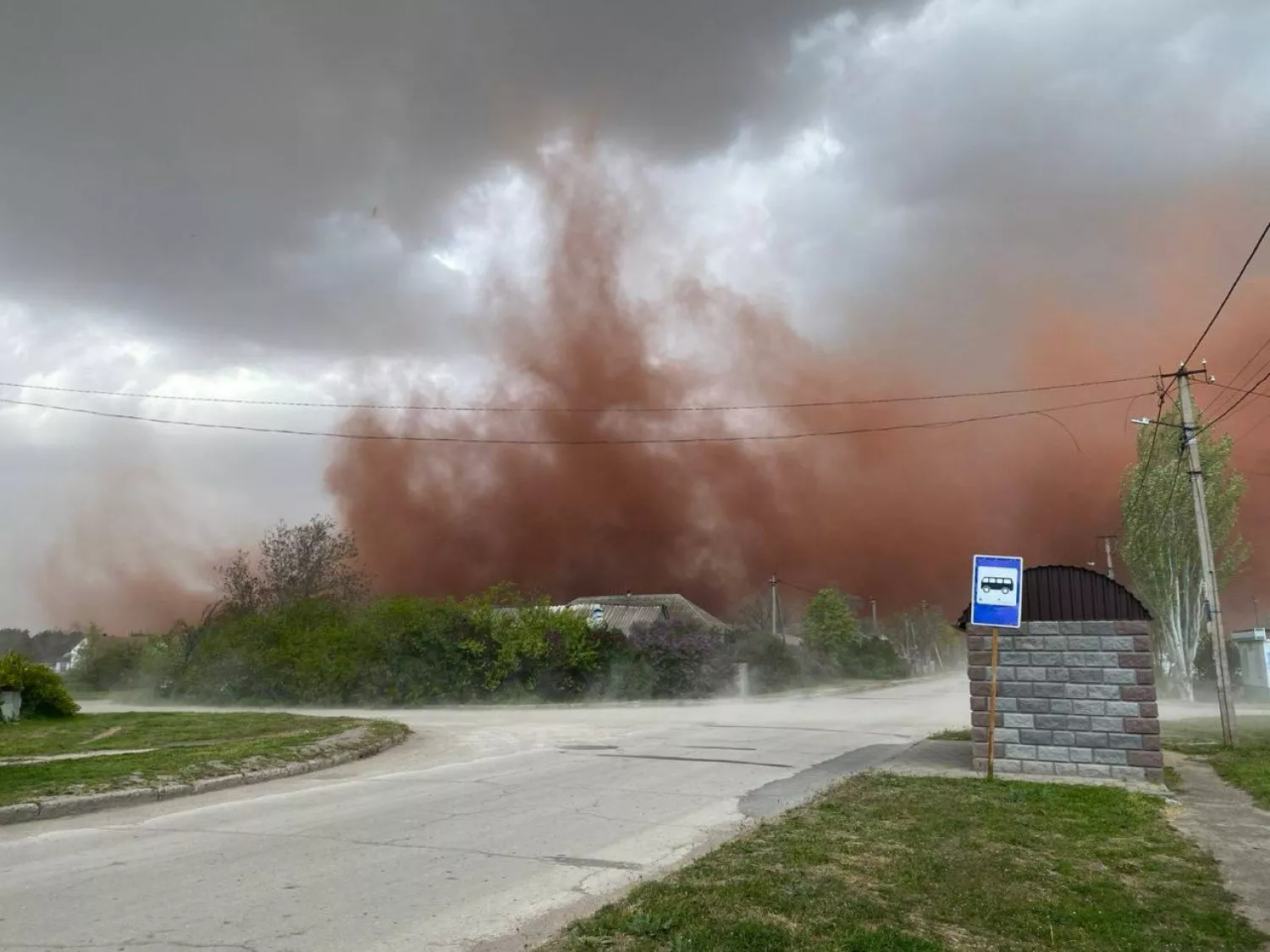 The streets of the village of Lymany near Mykolaiv, shrouded in dust from the MAP’s sludge fields. Photo from social media
The State Property Fund commented on the situation regarding the red sludge dust from the sludge storage facilities of the «Mykolaiv Alumina Plant». They noted that they were aware of the problem and were monitoring it.
The Fund’s deputy chairman, Vitalii Kovalenko, described the incident as an «extreme climatic emergency».
